


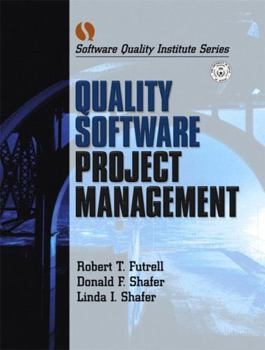
Quality Software Project Management, Two Volume Set

Drawing on best practices identified at the Software Quality Institute and embodied in bodies of knowledge from the Project Management Institute, the American Society of Quality, IEEE, and the... This description may be from another edition of this product.
Format:Paperback
Language:English
ISBN:0130912972
ISBN13:9780130912978
Release Date:January 2002
Publisher:Prentice Hall
Length:1680 Pages
Weight:5.20 lbs.
Dimensions:2.3" x 7.4" x 8.9"
Customer Reviews
2 ratings
Indeed very practical for quality
Published by Thriftbooks.com User , 19 years ago
Such a comprehensive book cannot be wholly used by a practitioner. My interest is on quality. On this subject the book is very practical and can direct all those that are hands-on in a project team. Chapter 30 is very useful for those involved with CMM Level 1 Quality Assurance. That is the start, because from there one can consult others chapters to have a broad view of a project and be prepared to interact with peers.
Best from among 2 dozen I've read on the subject
Published by Thriftbooks.com User , 24 years ago
This is, without a doubt, the most comprehensive book available on software project management. I don't make this statement lightly - I have over two dozen books on the subject, and have reviewed a significant portion of them on this site. It isn't the fact that the book consists of 33 chapters and 7 appendices and consumes nearly 1700 pages that makes it comprehensive. What distinguishes this book from the rest are:(1) A process-oriented approach that is completely consistent with the PMI PMBOK, fully supports requirements for the higher levels of the capability maturity model, and can be adapted to virtually any life cycle model.(2) It completely covers the important elements of planning, scheduling and control, including work breakdown structure development, associating tasks and deliverables, estimating (the focus is on the constructive cost model), advanced scheduling techniques (including critical chain scheduling that has emerged from the theory of constraints body of knowledge), and earned value project management.(3) Ties software engineering, system engineering, reliability, SQA and software configuration management to the project process. Many books briefly address these, while this book addresses the requirements, issues and techniques head-on.(4) Business plan development, requirements analysis, project deliverables and other artifacts are thoroughly covered.(5) The web site that augments this book has errata, templates and checklists (in HTML format), links and other material that supports using the book as a course text.There are so many things I like about this book, but the size and depth of content makes it nearly overwhelming. My favorite chapters are 21-Metrics, 26-Continuous Improvement, 28-Post Performance Analysis and 32-Legal Issues. However, these reflect my personal interests. The book is, in my opinion, uniformly excellent. The only flaw I found was the scant attention given to releasing an application or system into production, and no mention of how to tie together issue management to the enhancement and maintenance cycle that initiates once an application is in production. However, to be fair, this book is focused on project management and not software engineering. An outstanding companion to this book would be Successful Software Development by Scott E. Donaldson, Stanley G. Siegel, which provides the same in-depth treatment of software engineering as this book does for project management.
Copyright © 2026 Thriftbooks.com
Terms of Use | Privacy Policy | Do Not Sell/Share My Personal Information | Cookie Policy | Cookie Preferences | Accessibility Statement
ThriftBooks ® and the ThriftBooks ® logo are registered trademarks of Thrift Books Global, LLC
ThriftBooks ® and the ThriftBooks ® logo are registered trademarks of Thrift Books Global, LLC
