


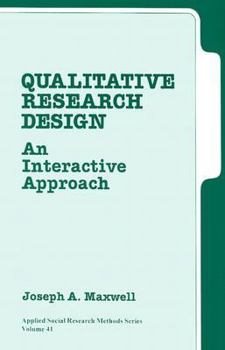
Qualitative Research Design: An Interactive Approach (Applied Social Research Methods)
(Book #41 in the Applied Social Research Methods Series)

Select Format
Select Condition 
Book Overview
Are you thinking about doing a qualitative study, or currently in the middle of one? If so, Joseph A. Maxwell′s Qualitative Research Design is the reliable guide for you. Taking a hands-on, innovative approach to qualitative design, it emphasizes the components of a design, how these interact with each other, and the environment in which the study is situated. Maxwell provides a clear strategy for creating coherent and workable relationships among these design components, highlighting the key design issues to deal with and describing the main considerations that inform your decisions about these issues. These design issues include clarifying the purpose of your study; creating a theoretical context for the research; formulating research questions; developing a relationship with the people you are studying; making decisions about sampling, data collection, and analysis; and assessing validity threats and alternative explanations to your study′s conclusions. The author also explains how to make the transition from your research design to your research proposal, providing an explicit model for the structure of a qualitative proposal that is based on the design of your study. Taking an exceptional approach to research design, Qualitative Research Design provides detailed exercises for applying its information and guidelines to your study.
Format:Paperback
Language:English
ISBN:0803973292
ISBN13:9780803973299
Release Date:April 1996
Publisher:SAGE Publications, Inc
Length:168 Pages
Weight:0.82 lbs.
Dimensions:8.8" x 0.5" x 5.8"
Customer Reviews
5 ratings
Great for your dissertation proposal!
Published by Thriftbooks.com User , 18 years ago
This was by far the most useful resource that I found for my dissertation proposal. Maxwell's writing is clear, smart, and informative. The sample proposal in the back of the book was extremely useful as well.
has no equal.
Published by Thriftbooks.com User , 19 years ago
This brief, thorough, and engaging introduction to qualitative research design has no equal. Maxwell avoids the superficial and confused paradigm discussions that so many qualitative authors engage in. He takes a pragmatic and rigorous approach that builds on the potential strengths of qualitative research while promoting well-accepted principles of scientific validity and integrity. The chapter on validity is especially noteworthy, recognizing that "Validity is a goal not a product; it is never something that can be proven or taken for granted" and that "Validity is also relative: It has to be assessed in relationship to the purposes and circumstances of the research, rather than being a context-independent property of methods or conclusions. Finally validity threats are made implausible by evidence not methods; methods are only a way of getting evidence that can help you rule out these threats." Amen.
Easy to Read
Published by Thriftbooks.com User , 20 years ago
This is the best book I have found that describes, in simple easy to read language, how to design qualitative research. I enjoyed reading it. The exercises included throughout the book facilitated my learning. I highly recommend it!
Maxwell provides roadmap
Published by Thriftbooks.com User , 25 years ago
Having acquired a veritable library of qualitative methods books and journal articles, I still felt like I was floundering. This book gave me not only a new and more valuable way of thinking about what I was doing, but a step-by-step action guide, practical, practicable, and with a depth (both explicated and in specific references) that makes me much more confident about eventual orals. Short and extremely sweet!
Buy this book!
Published by Thriftbooks.com User , 25 years ago
I and several of my compatriots found this text to be a practical island in an overwhelming and contradictory sea of theory. It's short, eminently readable, and especially useful for those struggling to write a qualitative dissertation proposal. Maxwell's liberating revision of the usual ponderous "lit review" to the actually applicable "research context" is in itself worth the purchase price.
Copyright © 2026 Thriftbooks.com
Terms of Use | Privacy Policy | Do Not Sell/Share My Personal Information | Cookie Policy | Cookie Preferences | Accessibility Statement
ThriftBooks ® and the ThriftBooks ® logo are registered trademarks of Thrift Books Global, LLC
ThriftBooks ® and the ThriftBooks ® logo are registered trademarks of Thrift Books Global, LLC
