


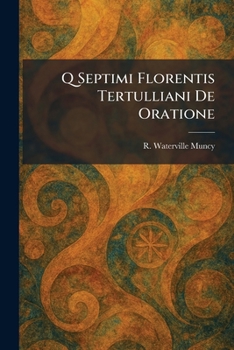
Q Septimi Florentis Tertulliani De Oratione

"Q Septimi Florentis Tertulliani De Oratione" is a seminal treatise on the nature and practice of Christian prayer, authored by the influential early Church Father, Tertullian. As one of the earliest surviving commentaries on the Lord's Prayer, this work provides a fascinating window into the devotional life, liturgical customs, and theological priorities of the North African Christian community during the late second and early third centuries.
In this scholarly edition prepared by R. Waterville Muncey, the text examines the profound spiritual significance of each petition within the Lord's Prayer. Tertullian moves beyond simple instruction to explore the essential requirements for effective prayer, including the necessity of a tranquil mind and a spirit free from anger or confusion. The work also addresses broader ecclesiastical practices, such as the kiss of peace, the posture of prayer, and the times set aside for devotion.
Renowned for its historical and literary value, "De Oratione" is a vital document for those studying patristics, church history, and the evolution of Christian doctrine. It highlights the transition from apostolic traditions to more structured liturgical forms and remains a cornerstone for understanding the foundational beliefs of the early Church regarding communion with the Divine.
This work has been selected by scholars as being culturally important, and is part of the knowledge base of civilization as we know it. This work was reproduced from the original artifact, and remains as true to the original work as possible. Therefore, you may see the original copyright references, library stamps (as most of these works have been housed in our most important libraries around the world), and other notations in the work.
This work is in the public domain in the United States of America, and possibly other nations. Within the United States, you may freely copy and distribute this work, as no entity (individual or corporate) has a copyright on the body of the work.
As a reproduction of a historical artifact, this work may contain missing or blurred pages, poor pictures, errant marks, etc. Scholars believe, and we concur, that this work is important enough to be preserved, reproduced, and made generally available to the public. We appreciate your support of the preservation process, and thank you for being an important part of keeping this knowledge alive and relevant.
Customer Reviews
ThriftBooks ® and the ThriftBooks ® logo are registered trademarks of Thrift Books Global, LLC
