


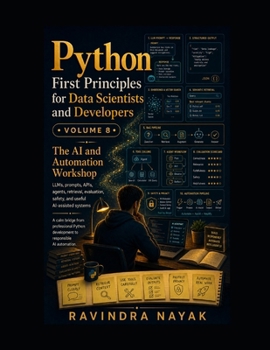
Python First Principles for Data Scientists and Developers Volume 8: The AI and Automation Workshop

Volume 1 helped you understand Python thinking.
Volume 2 helped you build practical programs.
Volume 3 helped you organize information with data structures.
Volume 4 helped you work with real data using NumPy and pandas.
Volume 5 helped you visualize data and think statistically.
Volume 6 helped you enter machine learning responsibly.
Volume 7 helped you build professional Python tools.
Volume 8 brings Python into the modern AI and automation world.
AI can feel mysterious. Prompts, models, tokens, embeddings, APIs, RAG, agents, and automation workflows can sound overwhelming to beginners. But behind the noise, the first principles are simple: input, context, reasoning support, output, evaluation, and human judgment.
Python First Principles for Data Scientists and Developers - Volume 8: The AI and Automation Workshop explains AI-assisted building step by step.
This volume teaches readers how to use Python with large language models, design better prompts, call APIs, structure AI outputs, search meaning with embeddings, build beginner-friendly RAG systems, understand agentic workflows, evaluate AI responses, protect privacy, and use AI responsibly in data science and software development.
Inside this volume, readers will learn:
How LLMs fit into the Python developer's workflow
How prompts work as instructions, context, and constraints
How to use APIs safely and practically
How structured outputs make AI results more reliable
How embeddings represent meaning
How semantic search finds ideas, not just keywords
How RAG connects documents with AI responses
How agents use tools, steps, and feedback loops
How to evaluate AI outputs instead of trusting them blindly
How to use AI for data science assistance
How to use AI for developer productivity
How to think about safety, privacy, bias, and responsible automation
How to build practical AI-assisted capstone projects
This is not a hype-driven AI book.
It is a practical workshop for building with AI calmly and responsibly.
By the end of Volume 8, readers will understand how Python, AI models, automation, and human judgment work together.
AI is not a replacement for thinking.
AI is a tool that becomes powerful when guided by clear thinking
Customer Reviews
ThriftBooks ® and the ThriftBooks ® logo are registered trademarks of Thrift Books Global, LLC
