


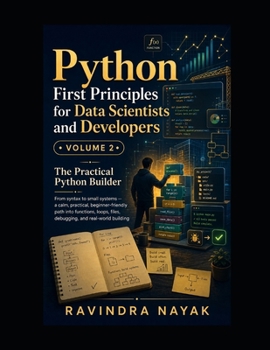
Python First Principles for Data Scientists and Developers: Developers Volume 3: The Data Structures Lab

Volume 1 helped you understand Python thinking.
Volume 2 helped you build practical programs.
Volume 3 teaches you how to organize information so your programs become clearer, smarter, and more useful.
Many beginners learn lists, dictionaries, tuples, and sets as separate syntax topics. But real confidence begins when you understand them as shapes of thought.
A list is for order.
A dictionary is for labels and lookup.
A set is for uniqueness.
A tuple is for fixed facts.
Nested data is for real-world records.
Python First Principles for Data Scientists and Developers - Volume 3: The Data Structures Lab breaks these ideas down slowly and practically. Through friendly explanations, interactive dialogues, guided examples, exercises, checklists, mini-projects, and a capstone learning tracker, readers learn how to choose the right structure before writing code.
Inside this volume, readers will learn:
How lists help store ordered information
How dictionaries connect keys to meaning
How tuples protect fixed facts
How sets remove duplicates and compare groups
How strings behave like structured text
How nested data represents real-world records
How comprehensions make repeated transformations cleaner
How searching, sorting, counting, and grouping work
How simple algorithm patterns prepare the mind for deeper problem solving
How data scientists and developers think differently about the same structures
This is not a rushed syntax reference.
It is a practical lab for building structured Python thinking.
By the end of Volume 3, readers will understand how information moves through Python programs, how patterns appear in data, and how small structures become the foundation for data science, automation, software tools, and machine learning.
Data enters.
Structure forms.
Insight begins.
Customer Reviews
ThriftBooks ® and the ThriftBooks ® logo are registered trademarks of Thrift Books Global, LLC
