


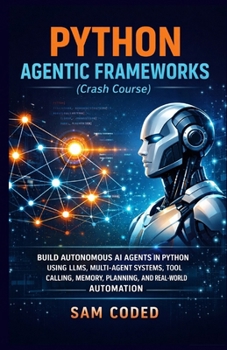
PYTHON AGENTIC FRAMEWORKS (Crash Course): Build Autonomous AI Agents in Python Using Llms, Multi-Agent Systems, Tool Calling, Memory, Planning, and Re
No Customer Reviews

Agentic AI refers to autonomous AI systems that can plan, reason, and act to achieve predefined objectives without constant human intervention. These systems typically incorporate LLMs as their core reasoning engine, augmented by tools for external interaction, memory for context retention, and planning mechanisms for multi-step tasks. Key characteristics include proactivity-anticipating needs rather than waiting for instructions-adaptability to dynamic environments, and the ability to collaborate with other agents or humans.
In contrast to generative AI, which excels at creating content such as text, images, or code based on prompts, agentic AI focuses on goal-oriented action. It can decompose complex tasks, select appropriate tools, handle errors through reflection, and iterate until the objective is met. This autonomy allows agentic systems to manage processes that were previously infeasible for automation, such as negotiating supply chain disruptions or conducting in-depth research across multiple sources.
The importance of agentic AI in 2025 cannot be overstated. Businesses face increasing pressure to operate with greater speed, resilience, and intelligence amid economic uncertainty, supply chain volatility, and talent shortages. Agentic systems address these challenges by scaling human-like decision-making across operations. For instance, they enable hyperautomation of end-to-end processes, reducing manual effort in areas like customer service, software development, and logistics. Early adopters report significant gains in productivity, with some achieving reductions in operational costs and faster time-to-resolution for complex issues.
In contrast to generative AI, which excels at creating content such as text, images, or code based on prompts, agentic AI focuses on goal-oriented action. It can decompose complex tasks, select appropriate tools, handle errors through reflection, and iterate until the objective is met. This autonomy allows agentic systems to manage processes that were previously infeasible for automation, such as negotiating supply chain disruptions or conducting in-depth research across multiple sources.
The importance of agentic AI in 2025 cannot be overstated. Businesses face increasing pressure to operate with greater speed, resilience, and intelligence amid economic uncertainty, supply chain volatility, and talent shortages. Agentic systems address these challenges by scaling human-like decision-making across operations. For instance, they enable hyperautomation of end-to-end processes, reducing manual effort in areas like customer service, software development, and logistics. Early adopters report significant gains in productivity, with some achieving reductions in operational costs and faster time-to-resolution for complex issues.
Format:Paperback
Language:English
ISBN:B0GC6Y2PG1
ISBN13:9798241027153
Release Date:December 2025
Publisher:Independently Published
Length:164 Pages
Weight:0.44 lbs.
Dimensions:0.3" x 5.5" x 8.5"
Customer Reviews
0 rating
Copyright © 2026 Thriftbooks.com
Terms of Use | Privacy Policy | Do Not Sell/Share My Personal Information | Cookie Notice | Cookie Preferences | Accessibility Statement
ThriftBooks ® and the ThriftBooks ® logo are registered trademarks of Thrift Books Global, LLC
ThriftBooks ® and the ThriftBooks ® logo are registered trademarks of Thrift Books Global, LLC
