


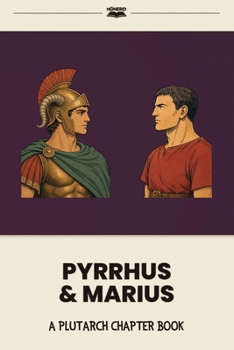
Pyrrhus & Marius: A Plutarch Chapter Book

Two soldiers who almost never lost a battle. One beat mighty Rome riding giant war elephants. One rose from a mud farm to save Rome from an invasion that had wiped out army after army sent against it. So how did each of them end up with almost nothing?
Two thousand years ago Plutarch did something new. He paired one famous Greek with one famous Roman, told both their lives, and then compared them, because he believed you cannot understand a person until you hold them up against someone who reached for the same things and became someone else. That final comparison, the synkrisis, is the reason he wrote in pairs, and it is the part children's versions almost always drop. This book gives the comparison a chapter of its own.
You see it best in the small moments. A wise friend asks Pyrrhus what he will do once he has conquered Rome, and then Italy, and then the whole world, and the quiet answer the king gives undoes his entire life in a single sentence. A poor Roman refuses Pyrrhus's gold and does not so much as flinch when a hidden war elephant is let loose, roaring, right over his head. And after one more terribly costly win, Pyrrhus says a line so sharp that we still use a version of it today.
What your child builds here is not a stack of facts about the ancient world. It is a habit: the ability to set two admirable people against each other and see exactly how their courage, or their hunger, or their judgment differed. The child who can compare Pyrrhus and Marius can later compare two leaders, two arguments, two choices in front of them.
The book is also honest about how we know any of this. A short closing chapter explains that Plutarch's own final verdict on these two men was lost long ago, which means the last word is left to the reader, and it plants the question good historians never stop asking: how do we know that?
It is a short, fully illustrated chapter book, and none of it is padding. It works read aloud or read alone, and it ends by pointing your child at the source, so the day they open a real Plutarch, the names are already familiar and the structure makes sense. Plutarch's Lives shaped Shakespeare, Montaigne, and the people who wrote the American Constitution. Your child gets them first, in a form they can use.
What this version does. It keeps the pair and the comparison whole. Your child follows two famous lives and learns to weigh them against each other, the skill the pair was built to teach.
Ages 6-10 - about 72 pages - about 7,300 words - Flesch-Kincaid grade 2-4 - 16 original vintage line illustrations - includes an "On Plutarch" comparison chapter - read-aloud or solo chapter book.
Content note. These are real ancient lives, and the book tells them honestly. There is war throughout, and both men die by the end, one in battle and one of old age. In his bitter old age, Marius also has his enemies hunted and killed in the streets of Rome. Nothing is gory, but the real cost of both lives, including their deaths, is on the page. A parent nearby helps with the darker turns.
Part of the n NERD Learning System. At 6-8, they're reading with growing independence. You're still there for the hard words and big ideas, but the book is becoming theirs. At 8-10, they're fully solo. The topics you introduced years ago finally click into place. Every Plutarch pair comes in four reading levels, each built for how children think at that stage, never a leveled-down rewrite. This is where it takes root.
Also available for Ages 0-4, Ages 3-7, and Ages 10-14.
Customer Reviews
ThriftBooks ® and the ThriftBooks ® logo are registered trademarks of Thrift Books Global, LLC
