


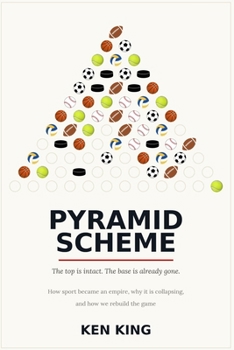
Pyramid Scheme: How Sport Became an Empire, Why It Is Collapsing, and How We Rebuild the Game

Sport is not an industry. It is a society, and it is dying the way societies die.
In Canada a child can play a sport through a school for about seventy dollars a year. Through a sport club, the same sport costs eleven hundred and twenty two.
Ken King spent twenty years inside that system as a collegiate coach and an administrator, explaining each problem separately, the way everyone does. Costs rose because everything rose. Officials quit because parents got worse. Adults stopped playing because life got busy.
Then he went looking for the numbers, and none of those explanations survived.
WHAT THE EVIDENCE ACTUALLY SHOWS
That the traits making a fourteen year old a standout are, on average, the same ones that predict not making it as an adult. That the families paying the most are buying measurably more injury, because money buys training volume and volume is the mechanism. That boys reporting fair or poor mental health went from seven per cent to nineteen in four years, and sport measures it nowhere. That officials are not quitting over abuse but over what happened after they reported it. That the free school door has quietly installed a tryout. And that adults did not stop playing at all: on a single Saturday morning, 438,526 people ran five kilometres, in something built with the exact opposite properties to ours.
At the top, a settlement designed to make college sport fairer concentrated twenty million dollars a year at a few dozen programs, and within months prosecutors were charging point-shaving schemes involving athletes paid nothing. Meanwhile leagues have built revenue on a betting market that pays people to make the result less real, spent it, and can no longer give it back.
ONE SYSTEM, NOT SEVEN PROBLEMS
Pyramid Scheme argues we have been analyzing sport with the wrong model. Industries fail when revenue falls. Sport's revenue has never been higher while the officials, the volunteers and whole clubs disappear underneath it. That is not how a business fails. It is how a society fails.
So the book treats organized sport as what it structurally is: a society roughly a hundred and sixty years old, with a governing class, a tax system, a credentialing priesthood, a founding myth, and a population that has quietly begun to leave. It follows the same mechanism from a seven year old's registration form, through the schools, the clubs, the volunteers and the adults who play, up through major junior and college athletics, all the way to a federal courtroom.
AND THEN THE HARDER HALF
The final third is a rebuild rather than a lament. Movement rights for young athletes. Open books. A governance model drawn from citizens' assemblies. And a thirteen indicator Collapse Index any organization can score in an afternoon using data it already holds.
It closes with an appendix of tools: action items for every level from the volunteer coach to the national body, a model movement clause short enough to adopt at a single board meeting, a worksheet that reveals what share of a family's fee reaches their own child, and four questions worth asking out loud at your next meeting.
Written for the board member, the club president, the coach, the official, the athletic director, the teacher who still runs a team, and every parent who has ever done the arithmetic in a hotel room in another city.
None of it requires permission from anyone above you.
Customer Reviews
ThriftBooks ® and the ThriftBooks ® logo are registered trademarks of Thrift Books Global, LLC
