
Skip to content
Scan a barcode
Scan
Hardcover Putt s Law Book

ISBN: 0471714224

ISBN13: 9780471714224

Putt s Law

Select Format

Select Condition ThriftBooks Help Icon

Recommended

Format: Hardcover

Condition: Like New

$32.49
Save $8.46!
List Price $40.95
Almost Gone, Only 1 Left!

Book Overview

"Technology is dominated by two types of people: those who understand what
they do not manage, and those who manage what they do not understand."
--Putt's Law

Early Praise for Putt's Law and the Successful Technocrat:

"This is management writing the way it ought to be. Think Dilbert, but with
a very big brain. Read it and weep. Or laugh, depending on your current job
situation."
--Spectral Lines, IEEE Spectrum, April 2006

"It's a classic. It reads at first like humor, but one eventually realizes
that it's all true. The first edition changed my life. I loaned my copy to
a subordinate at IBM, and he didn't return it to me until he was my boss."
--Dave Thompson, PhD, IBM Fellow (retired), Member National Academy of
Engineering, and IEEE Fellow

"Putt's humor ranges from sharp to whimsical and is always on target.
Readers will be reminded of many personal experiences and of lessons in
life they wish they had learned earlier in their careers."
--Eric Herz, former IEEE executive director and general manager

"Anyone who thinks 'engineering management' is an oxymoron needs to read
this terrific book -- then they will know."
--Norman R. Augustine, author of Augustine's Laws and retired Chairman & CEO
of Lockheed Martin Corporation

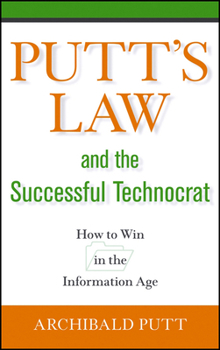
Putt's Law is as true today as it was when techno-everyman Archibald Putt
first stated it. Now, in Putt's Law and the Successful Technocrat: How to
Win in the Information Age, Putt is back with the unvarnished truth about
success in the modern, technology-driven organization.

As you learn the real rules of the technology world, you'll meet such
characters as the successful technocrat, Dr. I. M. Sharp. You'll find out
how he wrangles career victories from corporate failures, nearly
bankrupting the firm with his projects while somehow emerging the hero.
You'll also meet such unfortunates as Roger Proofsworthy, top-level
perfectionist yet low in the hierarchy, and come to understand how he
assiduously preserves his spot near the bottom of the totem pole.

Whether you work in business, IT, or are a freelance technocrat, you'll
want to study Putt's hard-won wisdom and laugh--all the way to the bank!

Customer Reviews

5 ratings

Putt returns with updated wisdom for the age of the web

Putt's laws and their corollaries were published in a series of articles in Research/Development magazine in 1976-1977, and then published in a book in 1981. The work was credited to the pseudonym of Archibald Putt. In this new edition, Putt updates his advice for the age of the web and even adds a few laws given the new technology. Putt's fundamental law is :"Technology is dominated by two types of people: those who understand what they do not manage, and those who manage what they do not understand." This was not just some cute clever saying that the author concocted. It can actually be logically derived. The author states that the only way to avoid the Peter Principle, which states that in a hierarchy every employee tends to rise to his level of incompetence, is creative incompetence. The author says technology is an anomaly because creative incompetence is common. Among the examples given are Albert Einstein. Einstein was one of those odd individuals who was so unkempt and eccentric that he would never be invited into the management club. Thus he was able to spend his entire career doing theoretical physics - never managing what he understood. The second anomaly is the lack of a competence criterion for technical managers, causing people to manage what they don't understand. These two anomalies together form a "competence inversion", hence Putt's law. Subsequent articles develop a series of corollaries, all of them witty yet tragically true. Some others are: "The maximum rate of promotion is achieved at a level of crisis only slightly less that that which will result in dismissal." "The value of an idea is measured less by its content than by the structure of the heirarchy in which it is pronounced." "The correct advice to give is the advice that is desired. The desired advice is revealed by the structure of the hierarchy, not by the structure of the technology." "A successful consultant never gives as much information to his clients as he gets in return." "Decisions are justified by benefits to the organization: decisions are made by considering benefits to the decision-makers." "Organizational stagnation occurs when the punishment for success is as large as for failure." Putt also includes some cogent advice such as Putt's Ploy: "If you must fail, fail big." For example, a scientist in a commercial lab who was supposed to be developing nonfading dyes instead discovers an insect repellant. The question is - is this success or failure? If it was failure then the scientist "failed big". However, this is not a dry book full of disjoint corollaries and proofs. Instead, Putt illustrates how his laws can be applied to your advantage through two opposing models: Dr. I.M. Sharp and Roger Proofsworthy. Dr. I.M. Sharp is a man of limited technical ability who transforms his corporate failures into personal successes. When his unworkable blue-sky project nearly bankrupts his company, he deftly applies techniques described by Putt and emerges victo

Kind of a Dilbert that's Written Down

Putt's Law: Technology is dominated by two types of people: those who understand what they do not manage, and those who manage what they do not understand. Every once in a great while a book like this comes around and changes the way you think of things. These books are usually small (like this one), easy to read (like this one), and are laugh out loud funny (like this one). It's only later when you are in the shower or just falling asleep that you recognize that 'yes, your organization just may be the one he is talking about.' Actually there are many laws in the book, most of which are backed up by examples -- I especially liked the one where the manager wanted to bring back vacuum from outer space. When it was pointed out that it would be too expensive, he had a stroke of genius and said that they could compress it, that way they could get more in the same sized container. No, this didn't come out of Dilbert, it came out of Putt's Law. You can view this as a written form of Dilbert.

How to Succeed in Business With a Sense of Humor

"Putt's Law" was recommended to me as a "fun read" by an old friend who toiled for many years in the computer industry. At first glance, the book seems to be primarily a collection of witty "laws" and whimsical situations describing life in the world of high technology. (My personal favorite: Putt's corollary to the famous dictum, "those who cannot remember the past are condemned to repeat it" - i.e., "every time history repeats itself, the price goes up.") I was pleased to discover that this book is as wise as it is witty. Its observations about the achievement of success in the world of high-tech business are right on target, and it is full of sage advice on how to survive and prosper as an engineer or manager. I would certainly recommend it as a useful guide to young men and women who are just entering the field, as well as to older readers who have seen it all. Thank you Archibald Putt, whoever you are!

Putt returns, better than ever

More than just a wise, witty, and knowing satire of large organizations, this book also explains how they got that way and what you can do about it. "Four Laws of Advice" is my favorite chapter, followed closely by "The Consultant's Law", since that's what I do now. This book is a gem!

Putt:The Unknown Technocrat Returns

If you want to jump-start your technology career, put aside your Peter Drucker, your Tom Peters, and your Marcus Buckingham management tomes. Archibald Putt is back. Who is Putt? Well, for those of you under 40, the pseudonymous Archibald Putt, Ph.D., penned a series of articles for Research/Development magazine in the 1970s that eventually became the 1981 cult classic Putt's Law and the Successful Technocrat, an unorthodox and archly funny how-to book for achieving tech career success. In the book, Putt put forth a series of laws and axioms for surviving and succeeding in the unique corporate cultures of big technology companies, where being the builder of the best technology and becoming the top dog on the block almost never mix. His first law, "Technology is dominated by two types of people: those who understand what they do not manage and those who manage what they do not understand," along with its corollary, "Every technical hierarchy, in time, develops a competence inversion," have been immortalized on Web sites around the world. The first law is obvious, but what's a competence inversion? It means that the best and the brightest in a technology company tend to settle on the lowest rungs of the corporate ladder-where things like inventing and developing new products get done-while those who manage what they cannot hope to make or understand float to the top (see Putt's first law, above, and a fine example of Putt's law in action in the editorial, "Is Bad Design a Nuisance?"). Other Putt laws we love include the law of failure: "Innovative organizations abhor little failures but reward big ones." And the first law of invention: "An innovated success is as good as a successful innovation." Now Putt has revised and updated his short, smart book, to be released in a new edition by Wiley-IEEE Press (http://www.wiley.com/ieee) at the end of this month. There have been murmurings that Putt's identity, the subject of much rumormongering, will be revealed after the book comes out, but we think that's unlikely. How much more interesting it is to have an anonymous chronicler wandering the halls of the tech industry, codifying its unstated, sometimes bizarre, and yet remarkably consistent rules of behavior. This is management writing the way it ought to be. Think Dilbert, but with a very big brain. Read it and weep. Or laugh, depending on your current job situation.
Copyright © 2026 Thriftbooks.com Terms of Use | Privacy Policy | Do Not Sell/Share My Personal Information | Cookie Policy | Cookie Preferences | Accessibility Statement
ThriftBooks® and the ThriftBooks® logo are registered trademarks of Thrift Books Global, LLC

GoDaddy Verified and Secured