


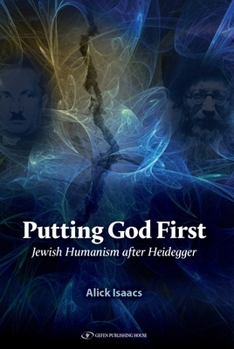
Putting God First: Jewish Humanism After Heidegger

For two centuries, much of the Jewish world has assumed that survival and prosperity lie in successful integration into Western civilization. Putting God First challenges that assumption at its root, arguing that the Holocaust reflects on modern humanism far more than the Jewish world has dared to admit, and that the State of Israel offers a historic opportunity to rebuild Jewish identity on its own spiritual ground.
Alick Isaacs distinguishes Jewish humanism, a theological idea, from Western humanism, and contends that confusing the two has made core Jewish ideas seem implausible to many modern Jews. Only by disentangling Judaism from the West, he proposes, can a healthy and peaceful relationship between them emerge.
Four movements, Segulah, Galut, Churban and Tikkun, lead from diagnosis to renewalEngagement with Kant, Derrida, Foucault, Wittgenstein, Hannah Arendt, Daniel Kahneman, Jonathan Haidt and othersAt its center, a close reading of Martin Heidegger's Being and Time, written as his thought moved toward NazismFresh readings of the Tanya, Sefat Emet, Nefesh HaChayim, Kedushat Levi, Rav Kook and the Maharal of Prague on the Nefesh, Neshamah, Tzelem Elohim, Am Segulah, Shabbat and the Land of IsraelA concluding vision of the State of Israel and a politics of Tikun OlamIsaacs, who holds a PhD in Jewish history from the Hebrew University, is the author of A Prophetic Peace: Judaism, Religion, and Politics. A demanding, original work of Jewish philosophy and theology for readers of Jewish thought and political philosophy, and for anyone asking what Jewish identity can mean after the Holocaust and the founding of Israel.
Customer Reviews
ThriftBooks ® and the ThriftBooks ® logo are registered trademarks of Thrift Books Global, LLC
