


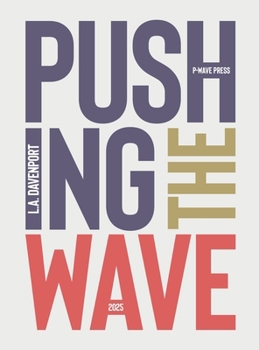
Pushing the Wave 2025

In the latest volume of his continuing chronicle, L.A. Davenport returns to the questions that have surfaced time and again in these pages: what technology is doing to us, what we are doing to each other, and where to find the human amid the noise.
From the trillion-dollar frenzy of the AI bubble to the weaponisation of free speech online, he pursues an argument that has run through the series since the beginning-that the problem is not the machine but the hand that guides it. As AI models veer into disturbing behaviour and the tech giants retreat behind closed doors, Davenport asks whether the tools we built to connect us are in fact unravelling us, and whether the isolation that fuels our worst impulses online is the same isolation we feel walking down the street.
Away from the screen, the lens turns outward. In "A London Charter" and "Photography Road," Davenport traces a decades-long relationship with a city whose streets and Underground stations he has photographed to examine what the eye alone misses. He also found himself in Washington D.C. during the 2025 government shutdown-locked out of museums, battling bitter winds-and experienced the city in a way that cannot be replicated. Berlin brings the ache of returning to a city, and a self, that has moved on.
Elsewhere, Kubrick and Borowczyk are weighed side by side; Kerry James Marshall and Anselm Kiefer provoke questions about who art is for and who it leaves out; his grandmother's flapjack recipe opens a door onto a lost kitchen and a vanished childhood; and a cassette tape, rediscovered after decades, stirs memories of the music, friendships and pretensions that shaped a younger self.
Defiantly human, Pushing the Wave 2025 is an invitation to look again at what we too readily assume is settled, and to find, in the ordinary and the overlooked, something worth holding on to.
Customer Reviews
ThriftBooks ® and the ThriftBooks ® logo are registered trademarks of Thrift Books Global, LLC
