


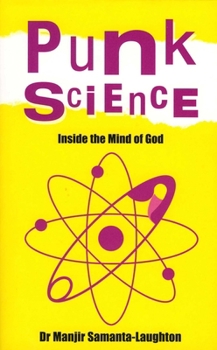
Punk Science: Inside the Mind of God

Select Format
Select Condition 
Book Overview
Punk Science demonstrates that ideas from the cutting-edge of science actually explain phenomena that have previously been thought of as paranormal. Dr. Samanta-Laughton offers a new model of the universe, where consciousness generates life, where black holes exist inside our bodies as well as far out in space, and where the same science explains galaxies and planets as well as human evolution, auras and chakras. Drawing on the very latest in scientific understanding, the Black Hole principle outlined by in this book, represents the next leap forward in both human understanding and living, and gives a closer approximation to scientific reality than the macho-approach of the old-style physics.
Format:Paperback
Language:English
ISBN:1905047932
ISBN13:9781905047932
Release Date:September 2006
Publisher:Hunt Publishing Limited, John
Length:320 Pages
Weight:0.87 lbs.
Dimensions:0.8" x 5.5" x 8.4"
Customer Reviews
5 ratings
This book will rattle your view of what is/is not for a long long time.
Published by Thriftbooks.com User , 17 years ago
Because science can explain that an event happened in space/time down to the most infinitesimal starting point, it assumes it has explained why this occurrence took place. In Punk Science, Dr. Samanta-Laughton attempts to address a host of "Big Questions" which, up till now, have been mere paradoxes. In particular she posits that scientists use the act of observation in their studies but do not address how humans are able to observe at all. At CERN in France, the 17-mile in circumference hadron collider, has been completed. It will attempt to uncover what types of energy/particles were responsible for the Big Bang and its immediate expansion into our known universe. However, if this underground machine produces even more infinitely small particles with no mass, the question will still linger: why did the Big Bang happen at all and how is it possible that humans are capable of observing the collider's results? In Punk Science, Doctor Samanta-Laughton provides an extremely persuasive argument for why things are the way they are: the universe, the world, living creatures, human beings, human thought, and the great mystery of the One--God. Early in Punk Science, Manjir explains why consciousness lies outside the human brain. In our ordinary everyday experience, we observe reality--chairs, cars, people, stars--as stable real objects in space, so much so, that we can measure them in four separate dimensions: length, width, height, and permanence through time. Liquids and gases we measure by volume and/or weight, but we know they are real. However, under a microscope, every one of these so called real objects is made of molecules which in turn are composed of tiny atoms. The atoms are built from smaller subatomic "thingies" which scientists have broken into even smaller particles. The CERN monster mentioned above is supposed to find the ultimate, infinitely small particles. But here's the rub. These small particles are not particles at all. Left alone, they are merely strings of probable energy with enormous spaces existing between them. When measured, they only appear as particles without mass. This is to say that when our brains make a conscious effort to locate them, the particles appear to exist because we stop their energetic movement. Unstopped, they are non-existent. In this sense, it is our act of consciousness that brings possible matter into existence. Thomistic/Scholastic philosophers during Medieval times may have been correct with their directive that things exist either in potentia or in actu (as possible beings or as real things). Furthermore, the human brain is made of matter. The logical conclusion of this entire argument is this: our consciousness gives human brains, chairs, cars, people, stars, liquids and gases their reality. Thus, consciousness must be an inherent quality of everything that exists. It does not reside in the brain. According to Punk Science, "consciousness is the soul of the universe." Further on in her
Breathtaking romp through quantum physics and spirituality
Published by Thriftbooks.com User , 17 years ago
This book will take you leaping and bounding through many of the latest findings in quantum physics. Woven throughout are references to ancient spiritual descriptions of cosmology from the Tao, Gnostic Gospels, and yogic chakra system, illustrating the congruence between those teachings with what we think we know about the nature of creation. The author's insight into the missing link between today's science and spirituality draws these elements together in a new and thought-provoking way. Not being a scientist, I can recommend this work to any layperson interested in a generalized overview of quantum physics, spiritual teachings, energetic healing and the integration amongst them. The author, a medical doctor, is obviously sincere, humble and curious in her seeking for answers and reconcilation between reductionist science, new science, and spirituality. In presenting her research and findings in an easy-to-read book, she proposes, and supplies evidence for, a new model of the universe's creation, a model different from creationism, big bang theory, and new age beliefs. With her ample bibliography, a reader can easily pursue more study of this relevant and eternal question.
Brilliant
Published by Thriftbooks.com User , 17 years ago
A very inspiring book with tons of new insights that will take you to infinity and beyond. Warm and fun to read.
A Very Worthy Read
Published by Thriftbooks.com User , 18 years ago
Manjir Samanta-Laughton's "Punk Science" is worth five stars. I recommend her book because of its groundbreaking insights, and this is despite of the book's significant weaknesses that I will also point out. Samanta-Laughton (page 13) writes: "The frontiers of science are revealing that the universe behaves as the mystics have told us all along." That I agree with this remarkable observation explains why I am willing to forgive the weaknesses of "Punk Science". Samanta-Laughton tells us that it is consciousness that has been omitted from a scientific world-view that sees the world only as material interactions. She (page 24) writes that, "science has led us full circle: by eliminating all discussion of consciousness, it has found that consciousness is inevitable in our universe and is inherent in all." Consciousness is hard-wired into the fabric of space-time! Samanta-Laughton (page 38) writes: "Not only do reductionist biologists have difficulty explaining the self-organizing nature of the cell, they have also failed to find satisfactory answers to how life first began. This fact is not apparent from the public image of science, which gives the impression that we know how life began and can continue with cloning sheep." And while referring to Bruce Lipton's work and others, she (page 59) writes: "We used to think of ourselves as victims of our inherited genes and the luck of the draw. Now we are realizing that we can learn to manage our beliefs and perceptions and therefore our own biology." Perception has found an essential ingredient in our biology, and it is the perception horizon that connects directly with consciousness (as we will see). Samanta-Laughton (page 64) writes - "Every atom, molecule, bacteria and cell is inherently intelligent. The information deep within every subatomic particle shapes life: form embryos to evolution. It is consciousness itself that undergoes evolution and this is reflected in the increasing complexity of species. The information of the form already exists and what we call physical matter follows suit." Her reference to "form" will be a big point, as the topic will eventually turn to a mirror image aspect of our one universe (the provider of form), a topic that will emerge from physics and take us into cosmology. Samanta-Laughton (page 84) refers to Rupert Sheldrake's "morphic resonance," a conception closely related to form. Samanta-Laughton describes new views of the quantum vacuum (QV), and she treats David Bohm's "holographic universe," and including Karl Pribram's vision of brain function. She (page 109) writes: "Having searched for the exact location of memory in the brain and not found it, does memory exists in the QV?" Samanta-Laughton (page 111) writes: "Most people have had the experience of thinking hard about a problem, putting the problem aside for some time only to find the answer appears suddenly when the mind is focused elsewhere. It is at these moments of least effort that we seem to find
The Universe Demystified
Published by Thriftbooks.com User , 19 years ago
This book will become your bible (burden?) of proof to the links between religion, mysticism, and science. It breaks down in everyday language the basics of quantum physics and readily sites its sources at the end of every chapter. The very words 'quantum physics' frightens most people as it conjures up thoughts of long, theoretical mathematic equations. You'll find none of that here, only a direct conversational tone, some modern culture wit and easily digestable facts about recent scientific discoveries and how they correlate with the contents of sacred texts and hidden knowledge. The author ties it all together exceedingly well and I can't imagine how anyone could read this book and not come away with a new level of thinking and perspective on the world around and within themselves. Highly reccommended.
Copyright © 2026 Thriftbooks.com
Terms of Use | Privacy Policy | Do Not Sell/Share My Personal Information | Cookie Notice | Cookie Preferences | Accessibility Statement
ThriftBooks ® and the ThriftBooks ® logo are registered trademarks of Thrift Books Global, LLC
ThriftBooks ® and the ThriftBooks ® logo are registered trademarks of Thrift Books Global, LLC
