


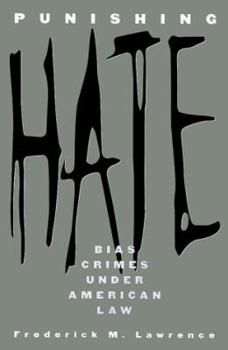
Punishing Hate: Bias Crimes under American Law

Select Format
Select Condition 
Book Overview
Bias crimes are a scourge on society. Is there a more terrifying image in the mind's eye than that of the burning cross? This text examines the nature of bias-motivated violence and provides a foundation for understanding bias crimes and their treatment under the US legal system.
Format:Hardcover
Language:English
ISBN:0674738454
ISBN13:9780674738454
Release Date:May 1999
Publisher:Harvard University Press
Length:282 Pages
Weight:1.15 lbs.
Dimensions:9.3" x 1.0" x 6.3"
Customer Reviews
3 ratings
A terrific and important read
Published by Thriftbooks.com User , 15 years ago
Understanding hate crimes is the first step toward stopping them. This book is compelling, provocative and well written. The author takes the reader on the journey of his research and expertise in a way that is both easy to understand and difficult to forget. Annette Annechild
The Right Blend of Academic Subtlety and Compassion
Published by Thriftbooks.com User , 15 years ago
Senator Kennedy's praise for this book was spot-on: Punishing Hate by Professor Frederick M. Lawrence presents a clear, cogent case for why and how to end impunity for hate crimes, and in doing so, to eradicate them from our societies. Lawrence has the right blend of academic subtlety and common touch, of assiduousness and compassion. He was among the first coiners of the terms "bias crime," which is more specific than "hate crime" in describing the motivation that lies behind such crimes of bigotry. In this book, Lawrence also coins the term "parallel crime," which has now entered the discourse (see: [...]) to refer to the crime that is similar in mechanics to, but vastly different in intent from, the bias crime in question. For example: Regarding breaking a synagogue's windows with bigoted intent, ordinary vandalism would be the "parallel crime." One can think of similar examples regarding bias crimes against people of any background, religion, color or creed: African-Americans, women, gay people, and ultimately -- this is Lawrence's universal definition of who should be considered a victim of a hate crime; he discusses the question in great detail -- people of any group where a country's "social fissure lines" lie, as Lawrence aptly phrases it. Lawrence shows how the parallelism in act between the bias crime and the "parallel crime" reveals the vast difference in the intent behind the act. This difference reveals why bias crimes inflict so much more pain on the individual -- and on the targeted community -- than the parallel crime. The deeper damage of a bias crime, in turn, reveals how bias crimes undermine society in a graver way, and why they must be seen differently, treated differently and punished more heavily than the parallel crime: because only in this way can we as a society deter people from committing bias crimes in the first place. Lawrence's contributions to scholarship -- and his numerous appearances giving testimony before Congress -- paid off in 2009 when President Obama signed the Hate Crimes Prevention Act of 2009 into law. I'd pick this book up if I were you. No book is perfect, but Punishing Hate is as close as it gets to indispensable.
Enlightening, Accessible, Specific, and Inspiring
Published by Thriftbooks.com User , 15 years ago
I found Lawrence's book, Punishing Hate, to be an enlightening, closely-reasoned guide to understanding hate crimes and how to combat them. Lawrence's writing is both scholarly and accessible, and his ideas are both wise and practical: for example, Lawrence's insight that after a hate crime, fellow members of the targeted group (e.g. blacks, women, Jews, gay people, et al.) feel not only sympathy for the victim, not only empathy for the victim, but the sense that they themselves have been attacked. I could go into more details here, but you're better off simply picking up the book. It is a shame that the reviewer below, "Dissident Aggressor," has chosen to rant at length, to recite untrue things (e.g. the book *does* define who should be considered a hate crime victim -- see the book's section on "social fissure lines" in Chapter 1), and to make ad hominem references to Lawrence's background. Oh, well, it *is* the internet; you never know what you'll find. One more reason to turn to this book. Few topics provoke as much confusion, vitriol and nonsense on the internet as hate crimes. Amid this cacophony, Lawrence's book is a clarion call of reason, and a call to action.
Copyright © 2026 Thriftbooks.com
Terms of Use | Privacy Policy | Do Not Sell/Share My Personal Information | Cookie Policy | Cookie Preferences | Accessibility Statement
ThriftBooks ® and the ThriftBooks ® logo are registered trademarks of Thrift Books Global, LLC
ThriftBooks ® and the ThriftBooks ® logo are registered trademarks of Thrift Books Global, LLC
