


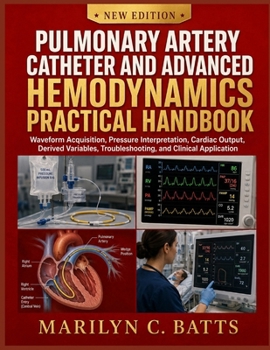
Pulmonary Artery Catheter and Advanced Hemodynamics Practical Handbook: Waveform Acquisition, Pressure Interpretation, Cardiac Output, Derived Variabl
No Customer Reviews

Master pulmonary artery catheterization and advanced hemodynamic interpretation with a practical clinical handbook built for bedside decision-making, waveform confidence, and safer patient management. This professional guide develops the reader's ability to move beyond isolated numbers and interpret hemodynamic data as an integrated physiologic picture. It begins with pulmonary artery catheter foundations, catheter anatomy, insertion pathways, transducer setup, leveling, zeroing, and dynamic-response verification. From there, it progresses through right atrial, right ventricular, pulmonary artery, and occlusion waveforms, emphasizing accurate acquisition before interpretation. Readers are guided through right- and left-sided filling pressures, pulmonary artery pressures, cardiac output measurement, intermittent and continuous thermodilution, Fick principles, mixed venous oxygen saturation, oxygen delivery and consumption, systemic and pulmonary vascular resistance, stroke volume, cardiac index, cardiac power, pulmonary artery pulsatility index, and other derived variables used in advanced hemodynamic assessment. The handbook places strong emphasis on clinical integration. Detailed discussions connect preload, afterload, contractility, ventricular interaction, ventilation, oxygen transport, and perfusion to the bedside presentation. Hemodynamic patterns are applied to hypovolemic, distributive, cardiogenic, obstructive, mixed shock, right ventricular failure, pulmonary hypertension, and advanced heart failure. Troubleshooting receives dedicated coverage, including damping and resonance, catheter migration, spontaneous wedge, overwedging, inability to obtain a wedge tracing, respiratory artifact, leveling and zeroing errors, inconsistent thermodilution measurements, discordant oxygen saturation data, arrhythmia-related problems, and interpretation under positive-pressure ventilation. Safety content addresses balloon management, pulmonary artery injury, arrhythmia and conduction risk, catheter migration, infection prevention, thrombosis, air embolism prevention, line and lumen safety, transport considerations, catheter removal, post-removal surveillance, and escalation when findings are unsafe or unreliable. Clinical cases, competency checklists, waveform verification tools, calculation aids, documentation templates, troubleshooting matrices, and review questions with rationales reinforce practical application throughout the book. Designed for nurses, advanced practice clinicians, critical care professionals, cardiovascular clinicians, clinical educators, and other professionals who work with invasive hemodynamic monitoring, this handbook provides a structured pathway from accurate measurement to confident interpretation, communication, and clinical decision support.
Format:Paperback
Language:English
ISBN:B0HHJY94W2
ISBN13:9798171399986
Release Date:September 2026
Publisher:Independently Published
Length:318 Pages
Weight:1.63 lbs.
Dimensions:0.7" x 8.5" x 11.0"
Customer Reviews
0 rating
Copyright © 2026 Thriftbooks.com
Terms of Use | Privacy Policy | Do Not Sell/Share My Personal Information | Cookie Notice | Cookie Preferences | Accessibility Statement
ThriftBooks ® and the ThriftBooks ® logo are registered trademarks of Thrift Books Global, LLC
ThriftBooks ® and the ThriftBooks ® logo are registered trademarks of Thrift Books Global, LLC
