


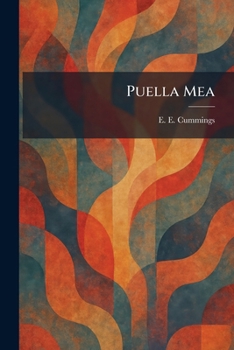
Puella Mea

"Puella Mea" is an exquisite and lyrical long poem by the celebrated American modernist poet E. E. Cummings. Written with the rhythmic vitality and innovative syntax that defined Cummings's early career, this work serves as a passionate and ornate tribute to a beloved woman. Taking its title from the Latin for "my girl," the poem draws on the traditions of classical lyric and courtly love poetry, reimagined through a uniquely twentieth-century lens.
The text is renowned for its vivid imagery and its playful yet profound exploration of romantic devotion. Cummings employs his signature stylistic flourishes-unconventional punctuation and a distinct focus on the visual architecture of the verse-to evoke the grace and beauty of the poem's subject. As a significant entry in Cummings's body of work, "Puella Mea" showcases the author's transition toward his mature voice, blending high-modernist experimentation with timeless emotional resonance. This piece remains a vital example of American lyricism, capturing the intensity of youth and the enduring power of the poetic imagination.
This work has been selected by scholars as being culturally important, and is part of the knowledge base of civilization as we know it. This work was reproduced from the original artifact, and remains as true to the original work as possible. Therefore, you may see the original copyright references, library stamps (as most of these works have been housed in our most important libraries around the world), and other notations in the work.
This work is in the public domain in the United States of America, and possibly other nations. Within the United States, you may freely copy and distribute this work, as no entity (individual or corporate) has a copyright on the body of the work.
As a reproduction of a historical artifact, this work may contain missing or blurred pages, poor pictures, errant marks, etc. Scholars believe, and we concur, that this work is important enough to be preserved, reproduced, and made generally available to the public. We appreciate your support of the preservation process, and thank you for being an important part of keeping this knowledge alive and relevant.
Customer Reviews
ThriftBooks ® and the ThriftBooks ® logo are registered trademarks of Thrift Books Global, LLC
