


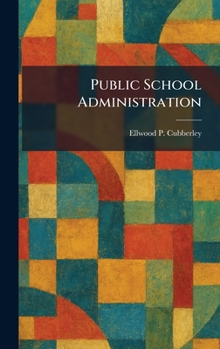
Public School Administration

"Public School Administration" is a seminal work in the field of educational management, providing a thorough analysis of the principles and practices required to oversee a modern school system. Written by the influential educator Ellwood P. Cubberley, this comprehensive text examines the organizational structures necessary for efficient public education, covering everything from state-level policy to the day-to-day operations of local districts.
The work delves into critical topics such as the functions of school boards, the professional role of the superintendent, and the systematic management of school finances and personnel. Cubberley emphasizes the importance of applying scientific management principles to education to ensure consistent standards and effective learning environments. As a historical document, "Public School Administration" reflects the administrative theories that helped shape the development of the American education system during the early 20th century. It remains an essential resource for scholars of educational history and those interested in the evolution of institutional governance and school reform.
This work has been selected by scholars as being culturally important, and is part of the knowledge base of civilization as we know it. This work was reproduced from the original artifact, and remains as true to the original work as possible. Therefore, you may see the original copyright references, library stamps (as most of these works have been housed in our most important libraries around the world), and other notations in the work.
This work is in the public domain in the United States of America, and possibly other nations. Within the United States, you may freely copy and distribute this work, as no entity (individual or corporate) has a copyright on the body of the work.
As a reproduction of a historical artifact, this work may contain missing or blurred pages, poor pictures, errant marks, etc. Scholars believe, and we concur, that this work is important enough to be preserved, reproduced, and made generally available to the public. We appreciate your support of the preservation process, and thank you for being an important part of keeping this knowledge alive and relevant.
Customer Reviews
ThriftBooks ® and the ThriftBooks ® logo are registered trademarks of Thrift Books Global, LLC
