


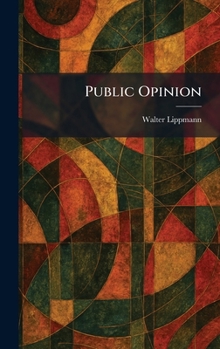
Public Opinion

Select Format
Select Condition 
Book Overview
"Public Opinion" is a foundational text in the fields of political science, communication studies, and sociology. This profound work explores the complex relationship between citizens, the media, and the democratic process. Walter Lippmann argues that the average individual lacks the time and specialized knowledge to accurately grasp the complexities of modern governance, leading to the creation of simplified "pseudo-environments" or "pictures in our heads" that often diverge from reality.
The book introduces the influential concept of the "manufacture of consent," examining how information is filtered through psychological biases, censorship, and social pressures. By analyzing the limitations of human perception and the power of symbols, "Public Opinion" challenges traditional democratic ideals and proposes a more technical, expert-driven approach to policy-making. This enduring masterpiece remains essential reading for anyone interested in the mechanics of propaganda, the ethics of journalism, and the psychological underpinnings of social behavior in a mass society.
This work has been selected by scholars as being culturally important, and is part of the knowledge base of civilization as we know it. This work was reproduced from the original artifact, and remains as true to the original work as possible. Therefore, you may see the original copyright references, library stamps (as most of these works have been housed in our most important libraries around the world), and other notations in the work.
This work is in the public domain in the United States of America, and possibly other nations. Within the United States, you may freely copy and distribute this work, as no entity (individual or corporate) has a copyright on the body of the work.
As a reproduction of a historical artifact, this work may contain missing or blurred pages, poor pictures, errant marks, etc. Scholars believe, and we concur, that this work is important enough to be preserved, reproduced, and made generally available to the public. We appreciate your support of the preservation process, and thank you for being an important part of keeping this knowledge alive and relevant.
Customer Reviews
Briiliant thinker, brilliant book.
www.sportofdistraction.com
A Classic on Political and Social Thought
A first-class Senior Citizen
ThriftBooks® and the ThriftBooks® logo are registered trademarks of Thrift Books Global, LLC
