


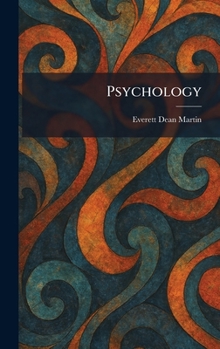
Psychology

"Psychology" is an insightful and foundational exploration of the human mind and behavior, authored by the influential social psychologist Everett Dean Martin. Based on a series of lectures delivered at the People's Institute in New York, this work offers a clear and systematic introduction to the field as it stood in the early 20th century. Martin expertly bridges the gap between complex academic theories and the curiosity of the general public, examining the shift of psychology from traditional philosophy toward an empirical, scientific discipline.
The text covers a diverse array of subjects, including the mechanics of consciousness, the power of habit, the role of instinct, and the social dimensions of human interaction. Martin provides a critical overview of contemporary psychological schools, such as behaviorism and psychoanalysis, while offering his own perspectives on the development of personality and the influence of the environment. By emphasizing the practical application of psychological insights, the work aims to help individuals better understand themselves and their place within society.
"Psychology" stands as a significant contribution to the history of social science, reflecting the intellectual vigor of the 1920s. It remains a valuable resource for readers interested in the evolution of psychological thought and the historical quest to unlock the mysteries of human nature.
This work has been selected by scholars as being culturally important, and is part of the knowledge base of civilization as we know it. This work was reproduced from the original artifact, and remains as true to the original work as possible. Therefore, you may see the original copyright references, library stamps (as most of these works have been housed in our most important libraries around the world), and other notations in the work.
This work is in the public domain in the United States of America, and possibly other nations. Within the United States, you may freely copy and distribute this work, as no entity (individual or corporate) has a copyright on the body of the work.
As a reproduction of a historical artifact, this work may contain missing or blurred pages, poor pictures, errant marks, etc. Scholars believe, and we concur, that this work is important enough to be preserved, reproduced, and made generally available to the public. We appreciate your support of the preservation process, and thank you for being an important part of keeping this knowledge alive and relevant.
Related Subjects
PsychologyCustomer Reviews
ThriftBooks ® and the ThriftBooks ® logo are registered trademarks of Thrift Books Global, LLC
