


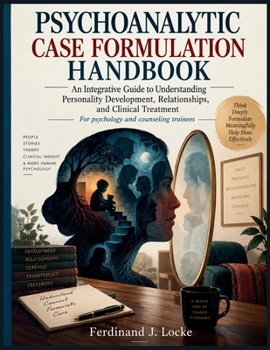
Psychoanalytic Case Formulation Handbook

Psychoanalytic Case Formulation Handbook gives psychology and counseling trainees a structured pathway from scattered clinical observations to coherent, clinically useful psychodynamic formulations. Rather than treating formulation as a fixed judgment, it teaches you to build hypotheses from evidence, question your assumptions, consider alternatives, and revise your understanding as the therapeutic relationship develops. Psychoanalytic Case Formulation...
Inside, you'll learn how to:
Connect symptoms with personality, development, relationships, affect, and unconscious conflict.Assess personality organization, defenses, attachment patterns, emotional regulation, and relational templates.Recognize transference, countertransference, resistance, repetition, and recurring interpersonal patterns.Integrate trauma, family systems, culture, identity, and social context into formulation.Move systematically from assessment findings to a clear, evidence-based psychodynamic formulation.Translate formulation into treatment priorities, therapeutic goals, and intervention choices.Write and collaboratively share formulations without reducing patients to diagnostic labels.The handbook moves progressively from foundational psychoanalytic concepts through clinical interviewing and formulation construction to treatment planning, supervision, and lifelong reflective practice.
Designed for developing clinicians, it emphasizes disciplined clinical reasoning, uncertainty, ethical practice, and respect for the patient's strengths-not simplistic interpretations or claims of hidden truth. Psychoanalytic Case Formulation...
Customer Reviews
ThriftBooks ® and the ThriftBooks ® logo are registered trademarks of Thrift Books Global, LLC
