


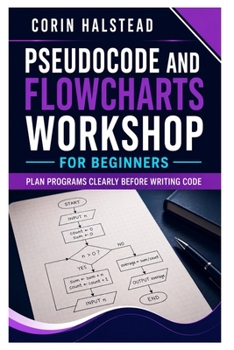
Pseudocode and Flowcharts Workshop for Beginners: Plan Programs Clearly Before Writing Code

Good programming starts before the first line of code.
Pseudocode and Flowcharts Workshop for Beginners: Plan Programs Clearly Before Writing Code by Corin Halstead teaches new programmers how to turn an unclear problem into a structured, testable solution before becoming distracted by language syntax.
Many beginners can follow coding examples but struggle when asked to solve a problem independently. This practical workshop builds the missing skill: understanding requirements, designing algorithms, tracing decisions, testing boundaries, and representing a solution clearly enough to translate into a programming language.
Inside, you'll learn how to:
Break everyday problems into precise requirementsIdentify inputs, processing, outputs, constraints, and exceptional casesDesign finite, ordered algorithmsCreate useful input-process-output analysesWrite consistent, readable algorithm descriptionsRepresent sequence, selection, and repetitionUse variables, constants, operators, and meaningful namesDesign one-way, two-way, and multiway decisionsHandle compound conditions and boundary valuesCreate reliable pre-test, post-test, count-controlled, sentinel, and validation loopsDivide larger solutions into procedures, functions, and modulesWork with lists, searches, totals, minimums, maximums, and averagesBuild trace tables and desk-check algorithmsDesign normal, boundary, invalid, empty, and alternative-path testsDiagnose common logic defects before implementationRefactor unclear solutions without changing required behaviorTranslate tested designs into introductory Python structuresThe book uses a repeatable development cycle: understand, define, design, trace, test, refine, and implement.
Later chapters connect the planning techniques to working Python and then combine them in complete projects involving a personal budget checker, student result analyzer, and inventory reorder assistant.
No previous programming experience is required. The book is designed for students, self-taught learners, career switchers, working professionals, aspiring developers, testers, analysts, support professionals, and anyone who knows some syntax but still finds a blank coding task difficult to approach.
Learn to understand the problem first, design the logic second, test the solution carefully, and only then turn it into working software.
Customer Reviews
ThriftBooks ® and the ThriftBooks ® logo are registered trademarks of Thrift Books Global, LLC
