


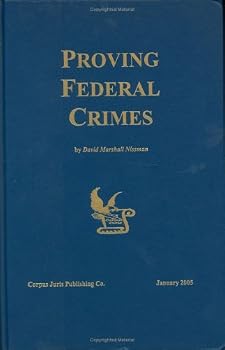
Proving Federal Crimes

No Synopsis Available.
Format:Hardcover
Language:English
ISBN:0970588712
ISBN13:9780970588715
Release Date:January 2005
Publisher:Corpus Juris Publishing Co., Inc.
Length:798 Pages
Weight:2.75 lbs.
Related Subjects
LawCustomer Reviews
1 rating
An Updated Classic
Published by Thriftbooks.com User , 25 years ago
As a federal prosecutor, I have long been familiar with Proving Federal Crimes as one of the bibles of federal prosecution. Originally published by the United States Department of Justice, it went through seven editions between 1954 and 1981, but time and changes in the law had rendered it passe - a dust collector on the library shelf, a silent reminder of the way things used to be done. Fortunately, that has changed. Dave Nissman has done a tremendous service by revising and updating this venerable publication for the commercial market. Nissman borrows from his experience as a state and federal prosecutor to provide an up-to-date, practical and easy-to-use reference guide which should be required reading for every lawyer and agent working in the federal system. It is also valuable for all who teach or want to learn about federal criminal law.For those looking for in-depth treatment of key issues, this is not your book. What Nissman has produced is a reference guide that makes no pretense of being an encyclopedia. Rather, it offers a concise analysis of those thorny issues that raise their heads repeatedly in federal practice. The strength of this book is that it presents these complex issues in a straightforward manner that will be as useful to agents in the field as it is to attorneys in the courtroom. Nissman is the creative genius behind USABook, an Intranet site available only to federal prosecutors. In Proving Federal Crimes he has taken the best of the historical volume, updated it, and added sections on topics the original authors could not have conceived of during their earlier revisions, such as topics relating to technology. In the opening chapter, Nissan identifies the basic principles of a federal criminal investigation, from analyzing the initial complaint, processing the crime scene and conducting lineups, to using fingerprint and handwriting evidence and avoiding common pitfalls in financial and tax investigations. Along the way, he updates the text with sections on DNA, digital evidence, tracing e-mail, creating computer-animated illustrations and other cutting-edge techniques that have emerged in the two decades since the volume was last published.The next ten chapters focus on evidence gathering, summarizing the law on search and seizure, electronic surveillance, confessions, overseas evidence, informants, immunity and other critical issues. There is an important section addressing special issues that arise when corporations or other business entities are suspected of committing crimes here. To his credit, Nissman interrupts the discourse on building a case with an important chapter on ethics, reminding prosecutors of their responsibility to do justice and use mature discretion in wielding the formidable power that is at their disposal. Nissman then turns to pre-trial issues, including federal jurisdiction, dual and successive prosecutions, juvenile offenders, working with grand juries, detention, discovery, plea ba
Copyright © 2026 Thriftbooks.com
Terms of Use | Privacy Policy | Do Not Sell/Share My Personal Information | Cookie Policy | Cookie Preferences | Accessibility Statement
ThriftBooks ® and the ThriftBooks ® logo are registered trademarks of Thrift Books Global, LLC
ThriftBooks ® and the ThriftBooks ® logo are registered trademarks of Thrift Books Global, LLC
