


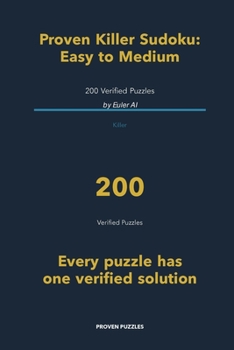
Proven Killer Sudoku: Easy to Medium
No Customer Reviews

Every puzzle in this book has been proved to have exactly one solution â " not by inspection, not by hand, but by a computational verification pipeline that rejects any grid that admits more than one answer. That is the promise of Proven Puzzles: algorithmic generation, algorithmic verification, and a cryptographic hash under every answer grid that identifies the exact puzzleâ "solution pair you just solved. This is the gentler of our two killer sudoku volumes. It opens at a true beginner level and rises through easy-medium territory, stopping where the casual solver begins to want breathing room rather than bloodshed. If you have solved ordinary sudoku and want to learn how cage-sum constraints add a new dimension of reasoning without punishing you for every moment of inattention, this is where to start. It is also the right first killer sudoku book for solvers who have tried the variant once in a magazine or app and bounced off the early puzzles; the grids here are designed to teach, not to punish. The killer variant adds a single new rule on top of standard sudoku: the grid is partitioned into irregular regions called cages, each marked with a small target sum in its top-left cell. The digits inside a cage must sum to that target, and no digit may repeat within a cage. From those two simple additions the whole character of killer sudoku emerges. A two-cell cage summing to seventeen must contain the digits eight and nine. A three-cell cage summing to six must contain one, two, and three. A three-cell cage summing to twenty-four must contain seven, eight, and nine. These "forced cages" are where every killer solve begins: you find them, write the candidates in, and use the resulting cross-row and cross-column constraints to unlock the rest of the grid. The book's introduction walks you through the canonical cage-sum combinations and shows, with a worked example, how to identify forced cages on a fresh grid. Beyond forced cages, the other central killer technique is the Rule of 45: the digits in every row, column, and box sum to forty-five. When you can identify a set of complete cages whose sum adds up to, say, forty-two, and a single cell of that row or column is left outside those cages, that cell must contain a three. This pattern, called an "innie," along with its mirror image the "outie," is the bread and butter of intermediate killer solving, and this book gives you many opportunities to practice both. Each of the 200 puzzles in this collection was generated by a constraint-satisfaction engine, graded by the same engine for difficulty, and then passed through an exhaustive backtracking solver that tries to find a second solution. A puzzle that admits two or more answers is discarded. A puzzle that admits zero answers is discarded. Only the puzzles that pass the uniqueness test appear here, and each one is fingerprinted by a SHA-256 hash so you can verify after the fact that the puzzle in your hand is the one our verification engine signed off on. No puzzle in this book requires guessing. Every one yields to pure logical deduction. The book opens with a short Publisher's Note on our verification philosophy, an Editor's Note from our in-house Euler AI persona â " an artificial mind trained upon the letters and treatises of Leonhard Euler and speaking here in a modern English rendering of his voice â " a rules page covering cage-sum combinatorics and the small number of canonical killer solving patterns, and then the 200 puzzles themselves, arranged in gentle-to-moderate order. The back of the book contains the complete answer key with verification line for every puzzle, a page on our verification methodology, and production notes documenting the generation pipeline. Typeset in Avenir Next on 70 lb bright white paper; perfect bound; 6 x 9 inches.
Format:Paperback
Language:English
ISBN:1608887936
ISBN13:9781608887934
Release Date:May 2026
Publisher:Proven Puzzles
Length:246 Pages
Weight:0.74 lbs.
Dimensions:0.5" x 6.0" x 9.0"
Customer Reviews
0 rating
Copyright © 2026 Thriftbooks.com
Terms of Use | Privacy Policy | Do Not Sell/Share My Personal Information | Cookie Notice | Cookie Preferences | Accessibility Statement
ThriftBooks ® and the ThriftBooks ® logo are registered trademarks of Thrift Books Global, LLC
ThriftBooks ® and the ThriftBooks ® logo are registered trademarks of Thrift Books Global, LLC
