


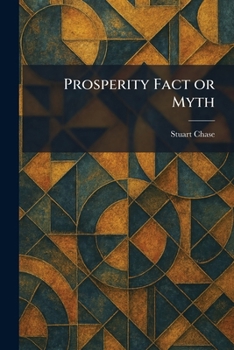
Prosperity Fact or Myth

"Prosperity Fact or Myth" is a critical examination of the American economic landscape during the 1920s, written by the influential economist and social theorist Stuart Chase. Written on the precipice of the Great Depression, the work investigates the underlying reality of the so-called Roaring Twenties to determine if the era's celebrated wealth was a sustainable achievement or a fragile illusion. Chase meticulously analyzes industrial productivity, income distribution, and the shifting standards of living for various social classes. He explores the impact of mass production and the rise of consumer culture, questioning whether these advancements truly translated into genuine security and well-being for the average citizen.
By dissecting the statistical data of the time, Chase challenges the prevailing optimism of the era and highlights the disparities between corporate growth and the actual financial health of the working class. "Prosperity Fact or Myth" serves as a foundational text for understanding the economic tensions that defined early 20th-century America. It offers a profound look at the mechanisms of modern capitalism and provides essential context for the economic collapse that followed. This insightful study remains a vital resource for readers interested in economic history, social theory, and the complexities of industrial progress.
This work has been selected by scholars as being culturally important, and is part of the knowledge base of civilization as we know it. This work was reproduced from the original artifact, and remains as true to the original work as possible. Therefore, you may see the original copyright references, library stamps (as most of these works have been housed in our most important libraries around the world), and other notations in the work.
This work is in the public domain in the United States of America, and possibly other nations. Within the United States, you may freely copy and distribute this work, as no entity (individual or corporate) has a copyright on the body of the work.
As a reproduction of a historical artifact, this work may contain missing or blurred pages, poor pictures, errant marks, etc. Scholars believe, and we concur, that this work is important enough to be preserved, reproduced, and made generally available to the public. We appreciate your support of the preservation process, and thank you for being an important part of keeping this knowledge alive and relevant.
Customer Reviews
ThriftBooks ® and the ThriftBooks ® logo are registered trademarks of Thrift Books Global, LLC
