


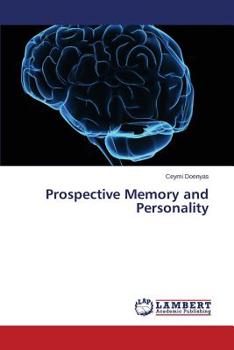
Prospective Memory and Personality
No Customer Reviews

Prospective memory enables individuals to remember to perform an intended action after a delay period. The first part of this book overviews models of brain mechanisms that aim to explain how prospective remembering works, including strategic models, automatic models, and the multiprocess model. It then reviews the neuroscientific evidence implicating various brain areas for different steps of prospective remembering, such as the hippocampus, the frontal cortex, and the parietal lobes. The second part of this book is the author's 2012 Princeton University thesis experiment investigating the relationship between different personality traits and the possible preference to use associations in episodic memory (EM) or active maintenance in working memory (WM) for prospective remembering. There was no significant correlation between type A personality, locus of control, different contingencies of self-worth and prospective memory success in EM and WM bias conditions of a prospective memory test, implying that regardless of their personality type, individuals may be able to adjust the memory they use for prospective remembering according to the different demands of each task.
Format:Paperback
Language:English
ISBN:3659780006
ISBN13:9783659780004
Release Date:November 2015
Publisher:LAP Lambert Academic Publishing
Length:100 Pages
Weight:0.35 lbs.
Dimensions:0.2" x 6.0" x 9.0"
Related Subjects
PsychologyCustomer Reviews
0 rating
Copyright © 2026 Thriftbooks.com Terms of Use
| Privacy Policy | Do Not
Sell/Share My Personal Information | Cookie Policy | Cookie Preferences | Accessibility Statement
ThriftBooks® and the ThriftBooks® logo are registered trademarks of Thrift Books Global, LLC
ThriftBooks® and the ThriftBooks® logo are registered trademarks of Thrift Books Global, LLC
