


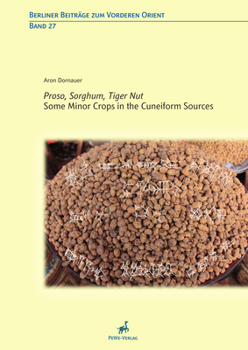
Proso, Sorghum, Tiger Nut: Some Minor Crops in the Cuneiform Sources
No Customer Reviews

The so called Fertile Crescent was home of some founder crops important in early agriculture: einkorn, emmer, barley, flax, chick pea, pea, lentil, and bitter vetch. However, research on the proportions and ubiquity of cultivated, measured, delivered, processed and consumed food crops shows a dramatic dominance of the cultivation of barley. Thus, one could assume that there was no significant interspecific but only intraspecific crop diversity and that Mesopotamian agriculture was a kind of a barley monoculture. In contrast, the plenty of cuneiform terms for cereal-like and legume-like plants might indicate some kind of biodiversity. Indeed, some cuneiform scientists specializing in crop plants and vegetables consider that some of the Sumerian se compounds, as well as their Akkadian equivalents, might be identified with millets, with some kinds of pulses such as bitter vetch and cowpea, or with some kind of tuber plants. Against this background, this study undertakes research on some Sumero-Akkadian taxa: In the first part of this study I evaluate some terms which several specialists propose to be millet or sorghum varieties: se'estub (se-estub) = arsuppu, semus (se-mus(3/5)) = segussu, sezahgebar (se-ne-ge-bar), segunu (se-gu-nu, se-gunu3) = segunu, se-ka, se-ka sig-ga = arsikku, se-ud-e-de3 = duhnu. In this context, the question that has to be asked is if it is possible that millets were cultivated in Babylonia as early as the late third millennium BC. To address this issue, the contribution of the Bronze Age Gulf trade in exchange for domesticated crops, including African and Asian millets, will be examined. Finally, the study discusses why, despite their excellent heat and drought tolerances, none of the millet species in arid Babylonia could displace the winter sown main crops. The second part addresses the question of whether the recently proposed identification of the Akkadian crop (se/u'qayyātu with Cyperus esculentus, a plant that has been demonstrated to have been present in ancient Egypt but not in Mesopotamia, is supported by the cuneiform evidence. I undertake some more detailed ecotrophological research on the use of qayyātu as an intermediate in the production of beer and foodstuff. In this context, I also study some other semi-baked and fermented intermediates.
Format:Hardcover
Language:English
ISBN:3935012306
ISBN13:9783935012300
Release Date:September 2018
Publisher:Pewe-Verlag
Length:166 Pages
Weight:1.10 lbs.
Dimensions:0.6" x 6.8" x 9.6"
Customer Reviews
0 rating
Copyright © 2026 Thriftbooks.com Terms of Use
| Privacy Policy | Do Not
Sell/Share My Personal Information | Cookie Policy | Cookie Preferences | Accessibility Statement
ThriftBooks® and the ThriftBooks® logo are registered trademarks of Thrift Books Global, LLC
ThriftBooks® and the ThriftBooks® logo are registered trademarks of Thrift Books Global, LLC
