


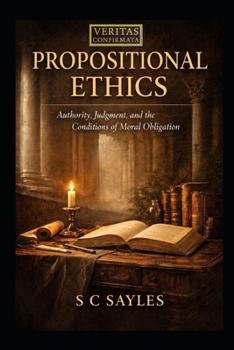
Propositional Ethics: Authority, Judgment, and the Conditions of Moral Obligation
No Customer Reviews

Propositional Ethics: Authority, Judgment, and the Conditions of Moral Obligation Every age speaks confidently about right and wrong. Moral language saturates public life-justice, harm, rights, dignity, responsibility-yet one question is persistently avoided: By what authority do moral claims bind at all? Propositional Ethics does not offer another ethical theory competing for attention alongside utilitarianism, deontology, or virtue ethics. It asks a more fundamental question-one that those theories quietly presuppose but rarely examine. Before ethics can judge actions, persons, or societies, ethics itself must be judged. This book argues that moral judgment is not optional, expressive, or merely social. It is irreducibly normative, binding, and inescapable. But binding judgment requires more than sentiment, consensus, reason, or outcomes. It requires authority-authority with the right to judge, not merely the power to enforce. Through a rigorous, proposition-driven analysis, Propositional Ethics shows: Why moral judgment cannot be reduced to preference, culture, or strategyWhy normativity entails obligation-and obligation entails authorityWhy authority must be jurisdictional to be legitimateWhy no immanent source (reason, outcomes, consensus, or tradition) can bear ultimate moral authorityWhy moral claims function as truth-claims requiring propositional clarityWhy accountability forces the question of ultimacyWhy ethics collapses into power when authority is denied or concealedWhy judgment cannot be suspended without contradictionThe conclusion reached is stark but unavoidable: ethics must either stand under confessed authority or abandon its claim to bind. There is no stable middle ground. Importantly, this volume does not name that authority. It stops precisely where philosophy must stop. Its task is not confession, but exposure-demonstrating that moral discourse cannot remain intelligible without answering a question it has long tried to evade. Propositional Ethics is written for philosophers, theologians, scholars, and serious readers dissatisfied with ethical systems that command obedience without explaining their right to do so. It is the first part of a two-volume work, preparing the ground for a theological answer without prematurely importing it. This is not a book about what to do. It is a book about whether ethics has the right to tell us what to do at all.
Format:Paperback
Language:English
ISBN:B0GG4HJCXD
ISBN13:9798243243926
Release Date:January 2026
Publisher:Independently Published
Length:450 Pages
Weight:1.32 lbs.
Dimensions:0.9" x 6.0" x 9.0"
Related Subjects
PhilosophyCustomer Reviews
0 rating
Copyright © 2026 Thriftbooks.com
Terms of Use | Privacy Policy | Do Not Sell/Share My Personal Information | Cookie Policy | Cookie Preferences | Accessibility Statement
ThriftBooks ® and the ThriftBooks ® logo are registered trademarks of Thrift Books Global, LLC
ThriftBooks ® and the ThriftBooks ® logo are registered trademarks of Thrift Books Global, LLC
