


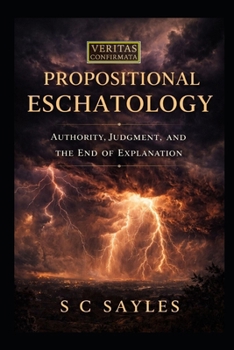
Propositional Eschatology: Authority, Judgment, and the End of Explanation
No Customer Reviews

What if the problem with modern eschatology is not which system is correct-but the assumption that the end exists to be explained at all? Propositional Eschatology is not another book about timelines, millennial schemes, or prophetic charts. It is a methodological reckoning. It argues that most eschatological debates fail before they begin, not because Scripture is unclear, but because authority has been quietly displaced by explanation.
Rather than asking what happens next, this book asks a prior and more decisive question: By what authority may anything be said about the end at all? Drawing on Scripture, juridical reasoning, and propositional clarity, S. C. Sayles presents a tightly structured argument that reorders eschatology from the ground up. The end is approached not as a future event to be mapped, but as judgment already operative-standing over history, interpretation, and the present moment. Systems are examined not for coherence, but for jurisdiction. Explanations are tested not for elegance, but for whether they have quietly exempted themselves from judgment. This book does not defend premillennialism, postmillennialism, amillennialism, or preterism. It places them under scrutiny. It does not harmonise prophetic texts. It identifies the court from which those texts speak. It does not promise resolution through explanation. It argues that finality comes through verdict. Written for readers who are dissatisfied with endless eschatological stalemate-pastors, theologians, philosophers, and serious students of Scripture-Propositional Eschatology offers a bracing alternative: not a new system, but a restored order. This is a book about the end of explanation-and why that is not an intellectual loss, but the recovery of authority.
If eschatology is judgment, not speculation,
then the question is no longer Which view is right?
but Who is the judge? This book refuses to let that question be avoided. Propositional Eschatology is not another account of how the end unfolds. It is an argument about authority.
Modern eschatology has become dominated by explanation-timelines, systems, and competing frameworks that promise clarity but produce stalemate. This book contends that the problem is not insufficient information, but misplaced jurisdiction. The end is not authoritative because it comes last in time, but because it renders final judgment.
Rather than offering a new eschatological system, S. C. Sayles identifies the conditions under which the end may be spoken of at all. Scripture is treated not as data to be arranged, but as testimony issuing from a court already in session. Christ is presented not as a participant within an eschatological programme, but as the authority from whom judgment proceeds. This is a book for readers who have grown weary of explanatory ends and are prepared to reckon with eschatology as verdict rather than speculation. The end does not wait to be explained.
It already stands in judgment.
Rather than asking what happens next, this book asks a prior and more decisive question: By what authority may anything be said about the end at all? Drawing on Scripture, juridical reasoning, and propositional clarity, S. C. Sayles presents a tightly structured argument that reorders eschatology from the ground up. The end is approached not as a future event to be mapped, but as judgment already operative-standing over history, interpretation, and the present moment. Systems are examined not for coherence, but for jurisdiction. Explanations are tested not for elegance, but for whether they have quietly exempted themselves from judgment. This book does not defend premillennialism, postmillennialism, amillennialism, or preterism. It places them under scrutiny. It does not harmonise prophetic texts. It identifies the court from which those texts speak. It does not promise resolution through explanation. It argues that finality comes through verdict. Written for readers who are dissatisfied with endless eschatological stalemate-pastors, theologians, philosophers, and serious students of Scripture-Propositional Eschatology offers a bracing alternative: not a new system, but a restored order. This is a book about the end of explanation-and why that is not an intellectual loss, but the recovery of authority.
If eschatology is judgment, not speculation,
then the question is no longer Which view is right?
but Who is the judge? This book refuses to let that question be avoided. Propositional Eschatology is not another account of how the end unfolds. It is an argument about authority.
Modern eschatology has become dominated by explanation-timelines, systems, and competing frameworks that promise clarity but produce stalemate. This book contends that the problem is not insufficient information, but misplaced jurisdiction. The end is not authoritative because it comes last in time, but because it renders final judgment.
Rather than offering a new eschatological system, S. C. Sayles identifies the conditions under which the end may be spoken of at all. Scripture is treated not as data to be arranged, but as testimony issuing from a court already in session. Christ is presented not as a participant within an eschatological programme, but as the authority from whom judgment proceeds. This is a book for readers who have grown weary of explanatory ends and are prepared to reckon with eschatology as verdict rather than speculation. The end does not wait to be explained.
It already stands in judgment.
Format:Paperback
Language:English
ISBN:B0GFCGGVKT
ISBN13:9798242845053
Release Date:January 2026
Publisher:Independently Published
Length:252 Pages
Weight:0.75 lbs.
Dimensions:0.5" x 6.0" x 9.0"
Customer Reviews
0 rating
Copyright © 2026 Thriftbooks.com
Terms of Use | Privacy Policy | Do Not Sell/Share My Personal Information | Cookie Policy | Cookie Preferences | Accessibility Statement
ThriftBooks ® and the ThriftBooks ® logo are registered trademarks of Thrift Books Global, LLC
ThriftBooks ® and the ThriftBooks ® logo are registered trademarks of Thrift Books Global, LLC
