


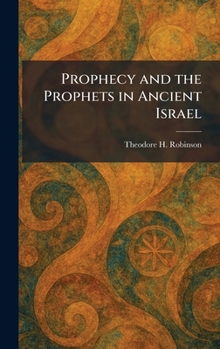
Prophecy and the Prophets in Ancient Israel

Select Format
Select Condition 
Book Overview
"Prophecy and the Prophets in Ancient Israel" offers a comprehensive exploration into one of the most significant religious phenomena of the ancient world. Theodore H. Robinson provides a detailed analysis of the nature of the prophetic movement, examining how individuals emerged to deliver divine messages that would shape the religious and moral landscape of Israel. The work delves into the psychological and social aspects of prophecy, distinguishing between the ecstatic experiences of early groups and the profound ethical insights of the great literary prophets.
Through careful scholarship, the book traces the historical evolution of the prophetic office, from its origins to its peak during the monarchic period. Robinson contextualizes the prophets within their contemporary political and social environments, showing how their calls for justice, faithfulness, and monotheism addressed the crises of their time. This study remains a vital resource for understanding the Old Testament, offering clarity on the stylistic features of prophetic literature and the enduring impact of these figures on Western religious thought. It is an essential read for students of biblical studies, ancient history, and theology seeking to grasp the spiritual foundations of the Hebrew Bible.
This work has been selected by scholars as being culturally important, and is part of the knowledge base of civilization as we know it. This work was reproduced from the original artifact, and remains as true to the original work as possible. Therefore, you may see the original copyright references, library stamps (as most of these works have been housed in our most important libraries around the world), and other notations in the work.
This work is in the public domain in the United States of America, and possibly other nations. Within the United States, you may freely copy and distribute this work, as no entity (individual or corporate) has a copyright on the body of the work.
As a reproduction of a historical artifact, this work may contain missing or blurred pages, poor pictures, errant marks, etc. Scholars believe, and we concur, that this work is important enough to be preserved, reproduced, and made generally available to the public. We appreciate your support of the preservation process, and thank you for being an important part of keeping this knowledge alive and relevant.
Customer Reviews
ThriftBooks ® and the ThriftBooks ® logo are registered trademarks of Thrift Books Global, LLC
