


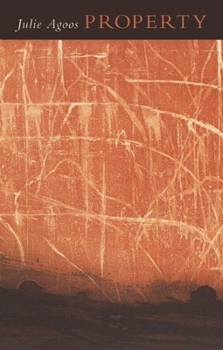
Property

Working within the frame of her native New England, Julie Agoos positions herself in her new book, Property , less as a first-person lyric speaker than as an acute listener to the layered history of small and large violences which ignite repeatedly in American life. Structured as a progression of poems which invoke the "genres" of oral history, gossip, legal transcript, and diary writing, Property arrives, in the long poem "Deposition," at the story of a particular, explosive, and horrific local crime. Property 's subject is historical and political: as she experiments from her unique lyric perspective with multiple ways of "telling"and explores through dramatic superimposition how the past inscribes and disturbs the present, Agoos interrogates our homegrown social and racial divides, and focuses emphatically on the ethics of living in a real and present world of ubiquitous war. Her images of natural beauty join a plain style derived from the rhythms of vernacular speech to challenge the complacenciesand consequences of her own American identity and belonging. Born in Boston in 1956, Julie Agoos is the author of two previous collections of poetry, Above the Land (Yale University Press, 1987) and Calendar Year (The Sheep Meadow Press, 1996). She taught for eight years as a lecturer in the creative writing program at Princeton University, and, since 1994, in the English department and MFA program in poetry at Brooklyn College/CUNY, where she is an associate professor. She lives in Nyack, New York.
Format:Paperback
Language:English
ISBN:1931337373
ISBN13:9781931337373
Release Date:May 2008
Publisher:Ausable Press
Length:112 Pages
Weight:0.70 lbs.
Dimensions:0.4" x 5.7" x 8.5"
Related Subjects
PoetryCustomer Reviews
1 rating
Deposition
Published by Thriftbooks.com User , 17 years ago
Julie Agoos's latest book of poems, "Property," is an extraordinary narrative concerned with telling a story about property and the horrors it has provoked over hundreds of years in the New England in which she grew up. Focusing on a quasi-mythical, yet particularized town, probably in New Hampshire, she constructs a picture of our culture with details of old violence on American soil-as far back as the Pequot War of 1637 and the interesting tale of a young American girl (of European descent), captured by Indians, who, given the choice, remains with her captors. But the story is centered on a crime of arson and gratuitous murder fueled by racism and hatred in the present. The center section of the narrative is the transcript of the trial with depositions of the town inhabitants, who serve as character witnesses or witnesses to the crime. Their accounts piece together for us only a partial explanation of the events through their revelations of the background of the actors in the gruesome murders. But how, Agoos asks, can we ever hope to know the real story whose origins are buried in the twisted values of this culture? Although her writing is often plain and stark, fitting the dark places of the soul from which the ugliness springs, there is a beauty in its severity. Her images and dramatic dialogue shock the reader into recognition of the hatred and brutality of which humans are capable. Agoos's poetry has always revealed her acute ability to see the world's surfaces and its corresponding depths. Her idiosyncratic sensibility invites us to look with her. Take, for example, the first "land portrait" in "Above the Land," her award-winning "Yale Series of Younger Poets" debut volume of 1986: ...the whole hill falls like an immense parcel wrapped in the same green paper I've seen stored in your house- that Cuban lime color. Or an impressionistic scene, that might easily serve as script directions from an Antonioni movie, from "Florence's Interlude" of the same collection: At noon, on the stair's elbow, the light falls, and soon each pair of pensioners comes down the walls darkening with their shadows. In "Franklin" she references some of the same events we learn of in Property: "Mrs. Phillip Call-scalped / by Indians, her family kidnaped / in the early years of purpose." But here the almost incidental detail is an item in a series meant to sharpen a composite picture of a town instead of its serving the thematic and integrated purpose of her latest work. Plato was wrong to banish poets from his ideal democracy. If Julie Agoos and her peers were senators and heads of state, the world would be the better for it.
Copyright © 2026 Thriftbooks.com Terms of Use
| Privacy Policy | Do Not
Sell/Share My Personal Information | Cookie Policy | Cookie Preferences | Accessibility Statement
ThriftBooks® and the ThriftBooks® logo are registered trademarks of Thrift Books Global, LLC
ThriftBooks® and the ThriftBooks® logo are registered trademarks of Thrift Books Global, LLC
