


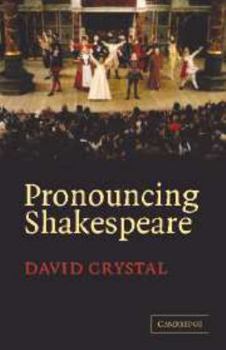
Pronouncing Shakespeare: The Globe Experiment


Select Format
Select Condition 
Book Overview
How did Shakespeare's plays sound when they were originally performed? How can we know, and could the original pronunciation ever be recreated? For three days in June 2004 Shakespeare's Globe presented their production of Romeo and Juliet in original, Shakespearian pronunciation. In an unusual blend of autobiography, narrative, and academic content, reflecting the unique nature of the experience, this 2005 book by David Crystal recounts the first attempt in over 50 years to mount a full-length Shakespeare play in original pronunciation. Crystal begins by discussing the Globe theatre's approach to 'original practices', which has dealt with all aspects of Elizabethan stagecraft - except pronunciation. A large section is devoted to the nature of the Early Modern English sound system. There are reports of how the actors coped with the task of learning the pronunciation, how it affected their performances and how the audiences reacted.
Format:Hardcover
Language:English
ISBN:0521852137
ISBN13:9780521852135
Release Date:May 2005
Publisher:Cambridge University Press
Length:188 Pages
Weight:0.80 lbs.
Dimensions:0.9" x 5.4" x 8.1"
Customer Reviews
3 ratings
Only concise available description of reconstructed Early Modern English pronunciation
Published by Thriftbooks.com User , 18 years ago
The title of my review states clearly what I was looking for in this book, and what I had found difficult to extract from the standard scholarly works of Kökeritz, Dobson, and Cercignani. I award this book four stars because it (and it alone, as far as I know) contains (buried in its chatty commentary about the weather, how the author doesn't get nervous before giving lectures, etc.) this simple desideratum. If you've ever felt frustrated that you couldn't find the 2-5 pp. account for Shakespeare equivalent to such easy-to-find information (on a basic level) as "How to pronounce Chaucer" or "The sounds of Italian," this book is a decent remedy. It would have been better (both for usefulness and book sales) for Crystal & Cambridge to have brought out, instead of this diffuse and incomplete large-font-with-lots-of-white-space-between-the-lines book, an even slenderer (but far more detailed and thorough) volume entitled "Shakespeare's Original Pronunciation: A Practical Guide, With Transcriptions." (Perhaps Crystal, because he is not an expert, was too modest to go this route, but the experts have conspicuously failed to provide this for teachers, readers, and actors.) If you want the meat of the reconstruction, actual phonetic information is contained only on pp. 13, 37-41, 47-54, 60-92, 115, 175-181 (and could have been distilled into a five-page handout). The rest of the book will mainly interest theater people who want additional behind-the-scenes commentary on how the production happened (dealing with actors' personalities, what the audience thought, etc.).
Extraordinarily interesting, exceptional
Published by Thriftbooks.com User , 18 years ago
Anyone interested in things Shakespearian will not be able to put this book down. I was astonished how interesting it was, and informative.
O, for a Muse of Fire!
Published by Thriftbooks.com User , 19 years ago
This book might not be the most inventive from a linguist's point of view, but for those, like myself, who are fascinated with modern Shakespeare performance and the Globe Theater, it is quite enjoyable. A welcome addition to any Shakespeare library.
Copyright © 2026 Thriftbooks.com Terms of Use
| Privacy Policy | Do Not
Sell/Share My Personal Information | Cookie Policy | Cookie Preferences | Accessibility Statement
ThriftBooks® and the ThriftBooks® logo are registered trademarks of Thrift Books Global, LLC
ThriftBooks® and the ThriftBooks® logo are registered trademarks of Thrift Books Global, LLC
