


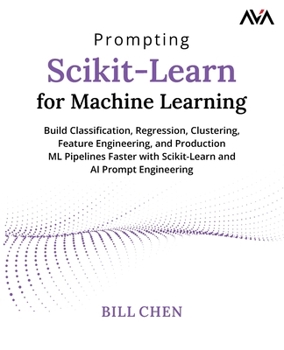
Prompting Scikit-Learn for Machine Learning

Prompt Smarter. Model Better. Deploy with Confidence.
Book Description
Machine Learning (ML) practitioners who know how to direct AI with statistical discipline are the ones building reliable production pipelines, while everyone else is still guessing and debugging. Prompting Scikit-Learn for Machine Learning shows you how to translate natural-language intent directly into rigorous, reproducible ML workflows using AI, accelerating every stage from problem framing and data preparation to model deployment and drift management.
Rather than treating AI copilots as magic, this book puts disciplined AI-assisted execution at the centre. You use prompt engineering techniques with ChatGPT and GitHub Copilot to build leak-safe preprocessing pipelines, train classification, regression, clustering, and ensemble models, engineer features, interpret results, and validate every output with proper statistical rigour throughout.
What you will learn
● Frame business problems as ML tasks, and identify when machine learning is the right solution.
● Build leak-safe preprocessing pipelines with proper splits, encodings, and feature engineering.
● Train and evaluate classification, regression, clustering, and ensemble models using scikit-learn.
Table of Contents
1. Introduction to Machine Learning and AI-Assisted Coding
2. Getting Started with Prompt Engineering
3. Data Wrangling and Preprocessing
4. Classification and Regression
5. Clustering and Dimensionality
6. Evaluation Metrics and Model Validation
7. Using ChatGPT for Prompt Engineering in ML
8. GitHub Copilot and Code Interpreter in Practice
9. AI-Enhanced Feature Engineering and Selection
10. AI-Assisted Model Tuning and Hyperparameter Optimization
11. Building an Explainable AI
12. Regression and Resource Efficiency
13. Clustering and Customer Segmentation
14. Responsible AI and Model Integrity
15. Becoming an AI-Empowered ML Practitioner
16. Future Trends and Best Practices of AI-Driven Scikit-learn
Index
Customer Reviews
ThriftBooks ® and the ThriftBooks ® logo are registered trademarks of Thrift Books Global, LLC
