


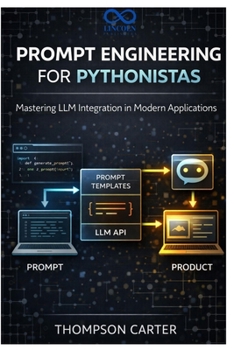
Prompt Engineering for Pythonistas: Mastering LLM Integration in Modern Applications

Large Language Models are powerful. Precise prompting makes them useful.
Python developers are at the center of the AI revolution. But integrating Large Language Models (LLMs) into real applications requires more than calling an API. It demands structured prompting, evaluation, cost control, and architectural discipline.
Prompt Engineering for Pythonistas is a practical guide to designing, testing, and deploying LLM-powered features in modern Python applications-without hype and without fragile demos.
What You'll Learn in This Book
The foundations of prompt engineering for developers
How LLMs actually process instructions
Writing structured prompts for reliable outputs
Few-shot, zero-shot, and chain-of-thought prompting
Managing context windows and token limits
Building Python pipelines around LLM APIs
Evaluating and improving model responses systematically
Designing production-ready AI features
The focus is on engineering rigor, not guesswork.
Who This Book Is For
This guide is ideal for:
Python developers integrating AI features
Backend engineers building LLM-powered services
AI engineers and applied ML practitioners
Startup teams shipping AI products
Developers moving from experimentation to production
Basic Python experience is recommended.
Why Prompt Engineering Is an Engineering Discipline
Prompting is not trial and error. When done properly, it becomes:
A structured design process
A reproducible experimentation workflow
A measurable optimization task
A critical layer of AI system reliability
This book teaches how to treat prompts as part of your architecture, not as ad hoc strings.
Customer Reviews
ThriftBooks ® and the ThriftBooks ® logo are registered trademarks of Thrift Books Global, LLC
