


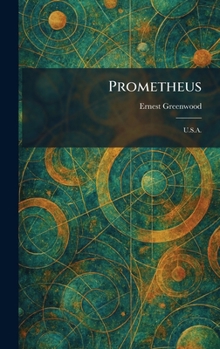
Prometheus: U.S.A.

"Prometheus, U.S.A." provides a comprehensive and engaging history of man's mastery over fire and the subsequent development of the power industry in the United States. Ernest Greenwood utilizes the mythical figure of Prometheus as a metaphor to trace the evolution of energy use, from the discovery of fire to the sophisticated gas and electric utilities of the early 20th century. The work examines how the harnessing of energy sources has served as the primary catalyst for industrial civilization and American economic expansion.
Through a detailed exploration of technological innovation and industrial organization, the book illustrates the transition from primitive fuels to the massive power grids that redefined modern life. Greenwood documents the growth of various energy sectors, providing historical context for the infrastructure that fueled the nation's rapid modernization. "Prometheus, U.S.A." stands as a significant historical document, capturing the optimism and industrial fervor of the 1920s while offering a profound look at the technological foundations of the modern world. It is an essential read for those interested in the history of science, technology, and the socio-economic impact of the American power industry.
This work has been selected by scholars as being culturally important, and is part of the knowledge base of civilization as we know it. This work was reproduced from the original artifact, and remains as true to the original work as possible. Therefore, you may see the original copyright references, library stamps (as most of these works have been housed in our most important libraries around the world), and other notations in the work.
This work is in the public domain in the United States of America, and possibly other nations. Within the United States, you may freely copy and distribute this work, as no entity (individual or corporate) has a copyright on the body of the work.
As a reproduction of a historical artifact, this work may contain missing or blurred pages, poor pictures, errant marks, etc. Scholars believe, and we concur, that this work is important enough to be preserved, reproduced, and made generally available to the public. We appreciate your support of the preservation process, and thank you for being an important part of keeping this knowledge alive and relevant.
Related Subjects
Engineering History Science Science & Math Science & Scientists Science & Technology TechnologyCustomer Reviews
ThriftBooks ® and the ThriftBooks ® logo are registered trademarks of Thrift Books Global, LLC
