


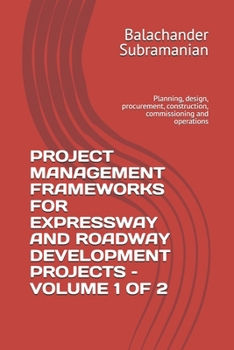
Project Management Frameworks for Expressway and Roadway Development Projects - Volume 1 of 2: Planning, design, procurement, construction, commission
No Customer Reviews

Modern highway and expressway infrastructure has evolved far beyond the traditional disciplines of road design and construction. Today's transportation projects are among the most complex engineering undertakings in the world, involving multidisciplinary engineering, environmental stewardship, stakeholder engagement, digital technologies, sophisticated procurement models, lifecycle asset management, and increasingly demanding governance requirements. Governments across the globe continue to invest billions of dollars annually in national highway networks, economic corridors, expressways, urban mobility systems, logistics corridors, and smart transportation infrastructure. At the same time, project owners face unprecedented challenges including rapid urbanization, climate change, land acquisition complexities, environmental regulations, utility coordination, funding limitations, digital transformation, and heightened public expectations. Delivering these projects successfully requires more than technical engineering expertise. It demands structured project management systems that integrate planning, governance, design management, procurement, construction management, quality assurance, risk management, project controls, sustainability, and operational readiness into one coordinated delivery model. Unfortunately, many highway projects continue to experience: Cost overrunsSchedule delaysScope creepDesign coordination failuresProcurement inefficienciesContractual disputesPoor stakeholder engagementQuality deficienciesSafety incidentsOperational challenges after project completionMany of these problems stem not from engineering limitations, but from inconsistent project management processes, fragmented decision-making, unclear governance structures, and the absence of standardized management frameworks. This book addresses these challenges by presenting a comprehensive collection of structured project management frameworks specifically developed for expressway and roadway development projects. Rather than focusing solely on engineering design, this book provides practical management frameworks that guide professionals through every stage of the project lifecycle. Each framework has been developed using internationally recognized project management principles while incorporating industry best practices from highway authorities, engineering consultants, EPC contractors, project management consultants (PMCs), and infrastructure developers. The frameworks contained in this volume cover strategic planning, project governance, project lifecycle management, corridor planning, scope management, design management, procurement strategy, construction planning, commissioning, operational readiness, and lifecycle asset management. They are intended to be practical implementation tools rather than purely academic models. Every framework follows a consistent structure that includes: Purpose and objectivesEnd-to-end lifecycle workflowsGovernance structuresRoles and responsibilitiesDetailed phase descriptionsDecision-making frameworksRisk managementDigital engineering integrationKey Performance Indicators (KPIs)Stage-Gate governanceCritical success factorsPractical implementation guidance
The content reflects the growing adoption of Building Information Modeling (BIM), Geographic Information Systems (GIS), Digital Twins, Common Data Environments (CDE), Artificial Intelligence, data analytics, intelligent transportation systems, and lifecycle asset management practices that are reshaping modern infrastructure delivery.
The content reflects the growing adoption of Building Information Modeling (BIM), Geographic Information Systems (GIS), Digital Twins, Common Data Environments (CDE), Artificial Intelligence, data analytics, intelligent transportation systems, and lifecycle asset management practices that are reshaping modern infrastructure delivery.
Format:Paperback
Language:English
ISBN:B0H98JPB88
ISBN13:9798187680191
Release Date:July 2026
Publisher:Independently Published
Length:526 Pages
Weight:1.54 lbs.
Dimensions:1.1" x 6.0" x 9.0"
Customer Reviews
0 rating
Copyright © 2026 Thriftbooks.com
Terms of Use | Privacy Policy | Do Not Sell/Share My Personal Information | Cookie Policy | Cookie Preferences | Accessibility Statement
ThriftBooks ® and the ThriftBooks ® logo are registered trademarks of Thrift Books Global, LLC
ThriftBooks ® and the ThriftBooks ® logo are registered trademarks of Thrift Books Global, LLC
