


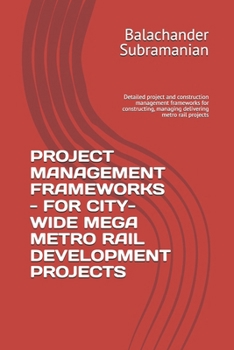
Project Management Frameworks - For City-Wide Mega Metro Rail Development Projects: Detailed project and construction management frameworks for constr
No Customer Reviews

Urbanization is transforming cities at an unprecedented rate, creating increasing demands for sustainable, high-capacity, safe, and efficient public transportation systems. Mega metro rail projects have emerged as the preferred solution for addressing urban mobility challenges, reducing traffic congestion, lowering carbon emissions, improving accessibility, and supporting long-term economic development. However, the planning and delivery of city-wide metro rail networks rank among the most complex infrastructure undertakings in the world. Modern metro rail developments involve extensive underground and elevated civil works, multi-modal transportation integration, advanced signaling and train control systems, traction power networks, telecommunications systems, rolling stock procurement, operations control centers, cybersecurity infrastructure, commercial developments, and transit-oriented urban regeneration initiatives. These projects frequently span multiple years, involve billions of dollars of investment, and require coordination among governments, transit authorities, contractors, consultants, financiers, regulators, utility agencies, operators, and communities. The success of mega metro rail projects depends not only on engineering excellence but also on robust project management systems capable of integrating scope, schedule, cost, quality, resources, risks, stakeholders, communications, safety, systems integration, operational readiness, and long-term asset performance. Fragmented project management approaches often lead to cost overruns, schedule delays, interface failures, contractual disputes, safety incidents, and operational inefficiencies. This book, Project Management Frameworks for Major Metro Rail Developments, provides a comprehensive and structured set of management frameworks specifically tailored to the unique challenges of metro rail delivery. The frameworks contained within this volume establish governance structures, management methodologies, lifecycle processes, performance controls, digital delivery practices, risk management approaches, and operational readiness strategies that support successful project outcomes. The book covers the complete metro project lifecycle from strategic planning and scope definition through construction management, systems integration, testing and commissioning, operational readiness, asset management, cybersecurity, emergency preparedness, business continuity, and smart mobility integration. Each framework has been developed using internationally recognized project management principles and adapted to the specific requirements of major urban rail transit systems. Special emphasis is placed on modern project delivery practices including: Integrated Program Management Offices (PMO)Digital Project ControlsSystems Integration ManagementCybersecurity GovernanceOperational Readiness and Transition (ORAT)Sustainability and ESG IntegrationSmart Mobility and MaaS EcosystemsAsset Lifecycle ManagementData-Driven Decision MakingResilience and Business Continuity PlanningThe objective of this book is to provide metro authorities, project sponsors, designers, contractors, consultants, operators, and infrastructure professionals with a practical reference that can be used to establish, improve, benchmark, and continuously enhance project management practices across the lifecycle of major metro rail developments. As cities continue to invest in large-scale public transportation infrastructure, the need for integrated and repeatable project management frameworks becomes increasingly important. This book serves as a roadmap for delivering metro rail projects that are safe, reliable, financially sustainable, operationally efficient, technologically advanced, and capable of supporting future urban mobility needs.
Format:Paperback
Language:English
ISBN:B0H4F4T3GQ
ISBN13:9798180479648
Release Date:June 2026
Publisher:Independently Published
Length:660 Pages
Weight:1.91 lbs.
Dimensions:1.3" x 6.0" x 9.0"
Customer Reviews
0 rating
Copyright © 2026 Thriftbooks.com
Terms of Use | Privacy Policy | Do Not Sell/Share My Personal Information | Cookie Policy | Cookie Preferences | Accessibility Statement
ThriftBooks ® and the ThriftBooks ® logo are registered trademarks of Thrift Books Global, LLC
ThriftBooks ® and the ThriftBooks ® logo are registered trademarks of Thrift Books Global, LLC
