


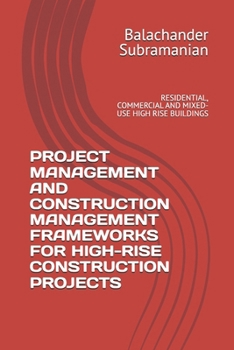
Project Management and Construction Management Frameworks for High-Rise Construction Projects: Residential, Commercial and Mixed-Use High Rise Buildin
No Customer Reviews

The global construction industry continues to witness an unprecedented demand for high-rise buildings driven by rapid urbanization, population growth, land scarcity, mixed-use developments, commercial expansion, and the need for sustainable urban infrastructure. High-rise construction projects have evolved into some of the most technically challenging and management-intensive endeavors undertaken by the engineering and construction profession. Unlike conventional construction projects, high-rise developments require the seamless integration of complex architectural concepts, advanced structural systems, sophisticated mechanical, electrical and plumbing (MEP) infrastructure, vertical transportation systems, fa ade engineering, digital technologies, sustainability requirements, and rigorous health and safety standards. These projects involve significant capital investment, multiple stakeholders, long delivery durations, regulatory complexities, and demanding performance expectations. The successful delivery of a high-rise project is rarely the result of technical excellence alone. It depends equally on the effectiveness of project management and construction management systems that govern decision-making, planning, execution, monitoring, control, commissioning, handover, and operational readiness. Over the past several decades, project failures across the construction industry have repeatedly highlighted common challenges: Inadequate governance structuresPoor stakeholder engagementScope creep and uncontrolled changesDesign coordination failuresCost overrunsSchedule delaysProcurement bottlenecksSafety incidentsQuality deficienciesContractual disputesIncomplete commissioningIneffective handover processesTo address these challenges, organizations increasingly rely on structured management frameworks that provide repeatable, scalable, and measurable approaches to project delivery. This book, Project Management and Construction Management Frameworks for High-Rise Construction Projects, has been developed as a comprehensive reference guide containing thirty-two practical frameworks that collectively cover the entire lifecycle of a high-rise development project. The frameworks presented in this book are designed to establish a structured management system that integrates project governance, strategic planning, engineering coordination, procurement management, construction execution, quality assurance, risk management, stakeholder engagement, sustainability, digital transformation, testing and commissioning, operational readiness, and project closeout. Each framework follows a consistent structure comprising: Framework overviewObjectivesPrinciplesGovernance structureLifecycle processesRoles and responsibilitiesPlanning methodologiesManagement proceduresPerformance measurement systemsKey deliverablesCritical success factorsThis practical format allows project teams to adapt the frameworks to projects of varying scale, complexity, procurement strategy, and geographical location.
Format:Paperback
Language:English
ISBN:B0H4YJVKKV
ISBN13:9798181214897
Release Date:June 2026
Publisher:Independently Published
Length:788 Pages
Weight:2.28 lbs.
Dimensions:1.6" x 6.0" x 9.0"
Customer Reviews
0 rating
Copyright © 2026 Thriftbooks.com
Terms of Use | Privacy Policy | Do Not Sell/Share My Personal Information | Cookie Policy | Cookie Preferences | Accessibility Statement
ThriftBooks ® and the ThriftBooks ® logo are registered trademarks of Thrift Books Global, LLC
ThriftBooks ® and the ThriftBooks ® logo are registered trademarks of Thrift Books Global, LLC
