


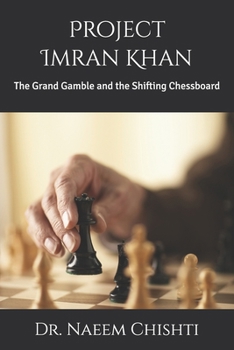
Project Imran Khan: The Grand Gamble and the Shifting Chessboard

Project Imran Khan: The Grand Gamble and the Shifting Chessboard is the first in-depth and critical examination of one of Pakistan's most ambitious and controversial political experiments. This groundbreaking book unpacks the rise, rule, and unraveling of Imran Khan's political ascent-an audacious attempt to reengineer Pakistan's power dynamics through a carefully calibrated civil-military project.
Written by an acclaimed author, this definitive account draws on extensive research and interviews to offer an unprecedented look into how Khan, once a cricketing icon, was propelled into the heart of power. It interrogates the forces behind his ascent, the military's dual role as strategic partner and shadowy overseer, and the far-reaching implications of the PTI's time in office for Pakistan's already fragile democracy.
The narrative traces Khan's transformation from privileged sportsman to populist crusader, mapping his entry into politics, the formation of the Pakistan Tehreek-e-Insaf (PTI), and the personal ideologies-centered on Naya Pakistan and moral politics-that shaped his appeal. It captures his early defeats and marginalization, but also the steady cultivation of a loyal, energized support base, especially among urban youth and the middle class.
The launch phase of the "project" is dissected in detail-highlighting the political choreography, media strategy, and elite alliances that turned Khan from perennial outsider into the establishment's preferred candidate. His 2018 victory is presented not just as a personal triumph, but the culmination of a broader institutional gamble-one that placed Khan at the apex of a system increasingly defined by hybrid governance.
But the grand gamble quickly turned turbulent. As Khan's government struggled with economic headwinds, institutional friction, and political missteps, the alliance that had elevated him began to fray. The book offers a penetrating look at the inner workings of PTI, growing military discomfort, and the eventual collapse of the coalition. The no-confidence vote and withdrawal of military support are analyzed not only as events, but as signs of a deeper systemic breakdown.
Public response to Khan's fall was anything but passive. The book captures the emotional intensity, polarization, and loyalty that followed-revealing how Khan's political identity had become inseparable from a generational and digital movement, one that continues to challenge traditional power structures.
The aftermath is equally critical. With PTI fragmented, Khan facing legal battles, and the establishment recalibrating its political strategy, the book examines what remains of the project-and what comes next. Will Khan return, or will he be eclipsed by a new political order? Can PTI survive without him, or will it be absorbed into the system it once vowed to upend?
The evolving role of the military is also explored in depth. From hybrid regimes to military-managed democracy, and from quiet control to overt recalibration, the institution's long game is laid bare. The book also addresses the influence of global powers-like China, the U.S., and the Gulf states-on Pakistan's internal governance calculus.
The final chapters look ahead. As the digital age empowers youth, and as political consciousness expands beyond traditional media and party structures, Pakistan stands at a crossroads. Is this the moment for systemic transformation, or merely another rotation of elites? Can the shifting chessboard of Pakistani politics allow for a genuine reset, or will the pieces fall back into place?
Project Imran Khan is not just a biography of a political figure; it is an anatomy of a grand political experiment-its architects, its executors, its consequences. With sharp analysis and evocative desciptions, this book is an indispensable guide to understanding Pakistan's past, present, and possible futures.
Customer Reviews
ThriftBooks ® and the ThriftBooks ® logo are registered trademarks of Thrift Books Global, LLC
