


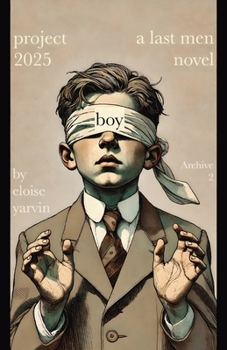
Project 2025 Boy: A Last Men Novel

Project 2025: Boy - A Last Men Novel is a dystopian political novel about memory correction, ideological collapse, and the remaking of identity inside a post-collapse reeducation system. Told through case files, proctor notes, institutional prompts, personal entries, and closing memos, the book follows Subject 1347, a boy being processed through the Flow's behavioral stabilization program after the fall of an older masculine order. What begins as a set of records about one child becomes a larger portrait of how power reshapes language, selfhood, and memory until obedience starts to feel like peace.
The novel moves through remembrance, reconditioning, restructuring, and final evaluation, building a world where authoritarian control no longer relies on spectacle or open brutality but on softness, repetition, documentation, and the quiet replacement of one internal system with another. What makes the book distinctive is its form. The institutional framing gives it a cold documentary texture, while the boy's entries create a psychological record of erosion from the inside. The result is a novel about the end of male memory, the politics of correction, and the unsettling possibility that a regime can rewrite a person not through punishment alone but through atmosphere, routine, and the gradual loss of contradiction.
The drawing images increase the tension and feelings of unease. The book includes the subject's drawn responses alongside written entries, and those images deepen the sense that the reader is looking through an actual archive rather than a conventional narrative. Family sketches, circles, symbolic marks, and partial figures do more than illustrate the text. They show the shrinking of self, the abstraction of memory, and the pressure of institutional interpretation. The drawings make the book feel more intimate and more clinical at the same time, reinforcing the idea that even a child's hand can become part of the machinery recording his own correction.
Written for readers of dystopian political fiction, speculative archive novels, psychological dystopias, authoritarian-future fiction, and literary books about memory, identity, and ideological control, Project 2025: Boy offers something unusually controlled and eerie. It is less interested in explosions than in soft domination, less interested in spectacle than in inward collapse. By pairing documentary structure with drawn images and a child's narrowing voice, it turns reeducation into atmosphere and makes the archive itself feel like part of the regime.
Customer Reviews
ThriftBooks ® and the ThriftBooks ® logo are registered trademarks of Thrift Books Global, LLC
