


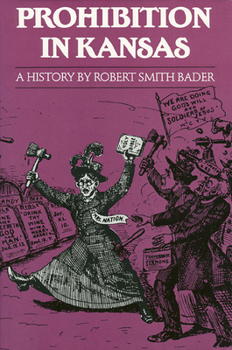
Prohibition in Kansas: A History


Select Format
Select Condition 
Book Overview
More than fifty years after repeal of the Volstead Act, this nation continues to debate the issues surrounding the use and control of alcohol. While the organized temperance movement in the United States is nearly as old as the nation itself, in no region of the country has the question of liquor control been of more consuming or enduring interest than in Kansas. Until now, however, there has been no broadly interpretive social history that chronicled prohibition in Kansas. Robert Bader's comprehensive account presents an even-handed analysis of the reform movement and of the role of women and of religion in it. In 1880, Kansas became the first state to write into its constitution a prohibition on alcohol, making it one of the very few states with extensive experience with prohibition as a public policy in both the pre- and post-Volstead periods. Since the campaign preceding the 1880 election, through the era of Carry Nation and national prohibition, up to the present day, the issue has been under continuous, and usually heated, public discussion. With remarkable ability, Bader dispels many of the shibboleths surrounding this reform movement, stressing both the accomplishments and triumphs of the "drys" as well as their failures and shortcomings. Based on sources never fully exploited before, this book transcends the Kansas experience and demonstrates important aspects of the national issue as well. In addition to social historians and those intrigued by the state's colorful past, anyone interested in alcohol studies, sociology, and public policy questions will also find this a model study.
Format:Paperback
Language:English
ISBN:0700602992
ISBN13:9780700602995
Release Date:June 1986
Publisher:University Press of Kansas
Length:336 Pages
Weight:1.50 lbs.
Dimensions:0.8" x 6.0" x 9.0"
Customer Reviews
1 rating
A Good Source
Published by Thriftbooks.com User , 19 years ago
I read this book as a background piece for a research paper I did on Kansas prohibition, and in that capacity I thought the book was very good. Bader gives an appropriate amount of attention to issues related to Kansas prohibition, such as prohibition on the national stage, woman's suffrage, Progressivism, the economy (in terms of both boom and bust), and gender roles. In this sense the book is about more than just prohibition in Kansas, but rather encompasses the other social phenomena that acted as the context for Kansas prohibition, especially in the political sense. In terms of covering the specific topic of Kansas prohibition, Bader does an excellent job, bring the reader from prohibition's origins in the second half of the 19th century through federal prohibition and repeal. I therefore recommend this book to anyone who is looking for background source material for their scholarly endeavors. For the lay public, this book will be a little too dry for anyone other than the exceptional history enthusiast.
Copyright © 2026 Thriftbooks.com Terms of Use
| Privacy Policy | Do Not
Sell/Share My Personal Information | Cookie Policy | Cookie Preferences | Accessibility Statement
ThriftBooks® and the ThriftBooks® logo are registered trademarks of Thrift Books Global, LLC
ThriftBooks® and the ThriftBooks® logo are registered trademarks of Thrift Books Global, LLC
