



Select Format
Select Condition 
Book Overview
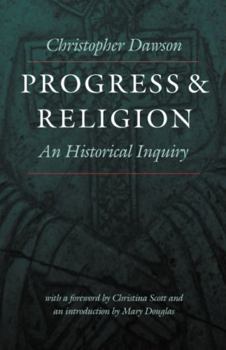
Foreword by Christina Scott and Introduction by Mary Douglas Progress and Religion was perhaps the most influential of all Christopher Dawson's books, establishing him as an interpreter of history and a historian of ideas. It has been described as a brilliant work of synthesis, for in this single volume he outlined his main thesis for the history of culture, which was his life's work. Anthropology, sociology, philosophy, religion, and history formed the backdrop for the key idea of his thought--namely, that religion is the soul of a culture and that a society or culture which has lost its spiritual roots is a dying culture. To Dawson, a return to the Christian culture that had formed Western civilization was the only remedy for a world adrift. Dawson was writing in a period between the two great wars of the twentieth century, a time when some thought that the idea of progress had finally been discredited by the carnage and barbarism of the First World War. Progress and Religion was clearly intended to challenge the doctrine of progress, the rather na ve but persistent belief that 'in every day and in every way the world grows better and better.' Dawson argued that Western civilization was at a turning point and confronted with two real choices: reappropriate a vital Christian culture or move increasingly toward more dangerous and alienated expressions of consumerism and totalitarianism. In Progress and Religion , he contends that no culture could truly thrive if cut off from its religious roots. PRAISE FOR THE ORIGINAL EDITION: " Progress and Religion is undoubtedly a brilliant book. Its argument is closely reasoned, admirably presented, lucidly expressed. Its standpoint is original and suggestive, profound and illuminating. Without exaggeration, it may be regarded as one of the books of our generation."-- The Manchester Guardian , 1929 "A book of vast learning . . . a theme which invites the consideration of a stately procession of the greatest names in the history of the world's thought."-- The Scotsman , 1929
Format:Paperback
Language:English
ISBN:0813210151
ISBN13:9780813210155
Release Date:September 2001
Publisher:Catholic University of America Press
Length:226 Pages
Weight:0.72 lbs.
Dimensions:0.6" x 5.3" x 8.4"
Customer Reviews
2 ratings
Masterpiece
Published by Thriftbooks.com User , 20 years ago
In his overarching masterpiece, Dawson proves himself once again one of the most brilliant scholars of the twentieth century. The profound relation between religion and culture, the essential and forming influence of Christianity on Western civilization, and the secular crisis of the modern age is demonstrated impecably by Dawson here. As one professor has said, one can measure one's liberal arts education by how much one understands of this book.
Brilliant
Published by Thriftbooks.com User , 24 years ago
Christopher Dawson (1889-1970) was one the premier Roman Catholic thinkers of this century. Dawson's central concern was the relationship between religion and culture. Dawson drew on an extensive knowledge of history, philosophy, sociology and theology to illuminate this connection from the beginnings of history to the modern age.Although some of his books remain in print, Catholic University of America Press is printing new editions of his most important works. This edition of Progress & Religion contains a forward by Dawson's daughter Christina (1922-2001) and an introduction by the well-known sociologist Mary Douglas.Progress & Religion, which came out in 1929, is perhaps Dawson's most important work. Dawson argues that at the center of any great civilization is its religion, and this religion animates and gives it a sense of purpose. This is particularly the case with Christianity. "[T]he victory of the Church in the 4th century was not, as so many modern critics would have us believe, the natural culmination of the religious evolution of the ancient world. It was, on the contrary, a violent interruption of that process which forced European civilization out of its own orbit . . . ." [p. 126.] The Western Church vivified society by breaking with oriental spiritualism and showing that "human intelligence . . . finds its natural activity in the sphere of the sensible and particular." [p. 137.]It would make an interesting study to compare the work of Dawson with that of Robert Nisbet. Like Nisbet, Dawson was learned in the area of sociology and drew upon an extensive knowledge of sociologists such as Le Play, Comte and Durkheim. They both saw Rousseau as one the chief villains. As Dawson said, Rousseau effected a "new Reformation" and was the ideological godfather of the French Revolution. They both wrote extensively on the idea of progress. However, whereas Nisbet was "pious skeptic" (according to Prof. Gottfried), Dawson was a believer and his work contains a greater sense of urgency. Indeed, some of his writings between the wars were quite prophetic.
Copyright © 2026 Thriftbooks.com Terms of Use
| Privacy Policy | Do Not
Sell/Share My Personal Information | Cookie Policy | Cookie Preferences | Accessibility Statement
ThriftBooks® and the ThriftBooks® logo are registered trademarks of Thrift Books Global, LLC
ThriftBooks® and the ThriftBooks® logo are registered trademarks of Thrift Books Global, LLC
