


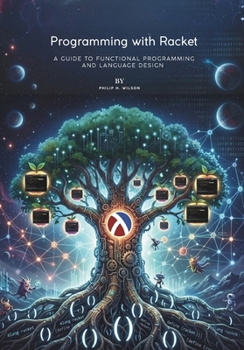
Programming with Racket: A Guide to Functional Programming and Language Design

I remember the exact moment I realized standard programming paradigms were holding me back. I was wrestling with rigid syntax, struggling to force complex business logic into inflexible structures. Then, I discovered Racket. Suddenly, I wasn't just writing code; I was designing the laws of the execution environment itself. You have likely felt that same frustration when a framework dictates what you can and cannot do. Imagine breaking free from those constraints. What if you could construct an entirely custom syntax tailored exactly to your domain? I wrote this guide to take you on that exact journey. You will transition from simply writing software to architecting the language it runs on. The learning curve is steep, but the absolute control you gain over your systems is unparalleled.
What's inside
Language Design: Step-by-step instructions for building custom parsers, readers, and evaluators.Advanced Macros: Mastering syntax objects and lexical hygiene to safely extend the compiler.Mathematical Security: Utilizing Typed Racket and strict module contracts for foolproof data validation.High-Performance Concurrency: Engineering multi-core architectures using futures, places, and non-blocking event loops.Enterprise Web Servers: Constructing continuation-based stateful servlets and secure database connection pools.Automated Testing: Setting up property-based testing and Continuous Integration pipelines.Who it's meant for
This guide is written strictly for developers, software architects, and technical engineers who are ready to push past the basics. If you are tired of relying on massive, opaque frameworks and want to understand the exact mechanics of language design, compilation, and concurrent execution, this is for you. You do not need prior experience with functional programming, but you must be ready to challenge how you think about software architecture.
Stop letting frameworks dictate your engineering potential. It is time to seize absolute control over your syntax, your compiler, and your runtime environment. Grab your copy today and start building the languages of tomorrow.
Customer Reviews
ThriftBooks ® and the ThriftBooks ® logo are registered trademarks of Thrift Books Global, LLC
