


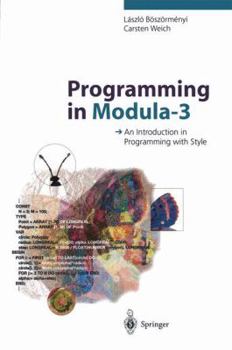
Programming in Modula-3: An Introduction in Programming with Style


Select Format
Select Condition 
Book Overview
This introductory text shows how to write and understand programs in Modula-3. The reader is led step by step toward complex data structures and algorithms, as far as object-oriented and parallel programming.
Format:Paperback
Language:English
ISBN:364264614X
ISBN13:9783642646140
Release Date:September 2011
Publisher:Springer
Length:571 Pages
Weight:1.83 lbs.
Dimensions:1.2" x 6.1" x 9.2"
Customer Reviews
1 rating
Learn Modula-3 in n Days, for n >> 15
Published by Thriftbooks.com User , 18 years ago
Published by Springer, this text is a comprehensive treatment of programming in general and Modula-3 in particular. The book is a thorough and very well organized introduction to Modula-3 (just what you would expect from Springer), but in no way is it a tutorial for light reading (just what you would expect from Springer). Springer books are often inaccessibly advanced, targeted at university graduate students and professors, and this one is no exception. However, even if you're a hobbyist you can still find this book useful, but like anything worthwhile you must be willing dedicate some time to it. The book covers all the Modula-3 language constructs including OOP, recursive algorithms, persistent data structures, and concurrent threads. The reading is occasionally dry and sometimes idiomatically strange, but you must keep in mind that the English edition is a translation of the German edition. Modula-3 is a member of the Niklaus Wirth family of programming languages that includes Pascal, Modula-2, and Oberon. These languages are characterized by very strict, strong, static, explicit typing. The hard work in learning one of these languages is getting your first few programs to compile, but the nice part is that once your program compiles, no matter how large it becomes there is a good chance it will run correctly (well, a better chance than with a language like C++ or PHP). In particular, if you're a fan of Pascal, Ada, Haskell, or ML, and you've been looking for a modern procedural/OOP language, then you will like Modula-3 and this book is a good place to start. However, if you're more accustomed to a loosely structured scripting language like Perl or PHP, or to a dynamically typed language like Python, Ruby, Lisp, or Scheme, or to a weakly typed language like C or C++, then the Modula-3 language will frustrate you much more than this book will. If you're a computer scientist, Modula-3 is a must-learn. It's certainly the best designed procedural/object-oriented language in existence. It gives you all the high-level features of an applications language: OOP, namespaces, a large base library, automatic memory management (i.e., garbage collection), plus low-level features of a systems language: pointers, encapsulation of unsafe code, direct hardware access, and extra things like first-class functions and garbage collected threads. Spend some time with this book and you'll learn more than just how to write Modula-3 programs, you'll learn about programming in general, and you'll learn about programming languages. I think the biggest problem with the book is the typeface used for the program examples: the publisher used a proportional sans-serif typeface in order to fit the examples onto the page, but this makes many of the examples a very dense read (thankfully, the examples are complete and plentiful, starting with the classically minimal "Hello, world!" program). Also, the authors' frequent use of syntactic patterns to formalize the
Copyright © 2025 Thriftbooks.com
Terms of Use | Privacy Policy | Do Not Sell/Share My Personal Information | Cookie Policy | Cookie Preferences | Accessibility Statement
ThriftBooks ® and the ThriftBooks ® logo are registered trademarks of Thrift Books Global, LLC
ThriftBooks ® and the ThriftBooks ® logo are registered trademarks of Thrift Books Global, LLC
