


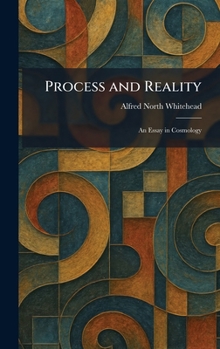
Process and Reality: An Essay in Cosmology


Select Format
Select Condition 
Book Overview
"Process and Reality" is a monumental work of speculative philosophy by Alfred North Whitehead, representing the definitive statement of his process metaphysics. In this profound "Essay in Cosmology," Whitehead seeks to construct a coherent, logical, and necessary system of general ideas that can interpret every element of our experience. He rejects traditional substance-based metaphysics in favor of an ontology centered on dynamic processes, "actual entities," and the interconnectedness of all things.
The text explores the categories of existence, explanation, and obligation, providing a rigorous framework for understanding the nature of being and becoming. Whitehead introduces key concepts such as "prehension," the "nexus," and the "primordial and consequent natures of God," bridging the gap between science and philosophy. This work serves as the foundation for modern process philosophy and has influenced diverse fields including physics, biology, and ecology. "Process and Reality" remains an essential read for those interested in the deep structures of reality, the relationship between the mind and the physical world, and the continuous evolution of the universe.
This work has been selected by scholars as being culturally important, and is part of the knowledge base of civilization as we know it. This work was reproduced from the original artifact, and remains as true to the original work as possible. Therefore, you may see the original copyright references, library stamps (as most of these works have been housed in our most important libraries around the world), and other notations in the work.
This work is in the public domain in the United States of America, and possibly other nations. Within the United States, you may freely copy and distribute this work, as no entity (individual or corporate) has a copyright on the body of the work.
As a reproduction of a historical artifact, this work may contain missing or blurred pages, poor pictures, errant marks, etc. Scholars believe, and we concur, that this work is important enough to be preserved, reproduced, and made generally available to the public. We appreciate your support of the preservation process, and thank you for being an important part of keeping this knowledge alive and relevant.
Customer Reviews
Process & Reality
The Brilliance of Hard Work and Imagination
Foundational work for Process Theology
Foundational work for Process Theology
Our century's best systematic metaphysic.
ThriftBooks® and the ThriftBooks® logo are registered trademarks of Thrift Books Global, LLC
