


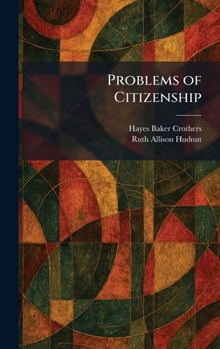
Problems of Citizenship

"Problems of Citizenship" is a comprehensive exploration of the societal and political challenges that defined the American landscape in the early 20th century. Written by Hayes Baker Crothers and Ruth Allison Hudnut, this foundational work examines the multifaceted nature of civic life and the various obstacles to effective governance and social harmony.
The text provides a detailed analysis of pressing issues such as immigration, racial tensions, labor disputes, and the evolving role of women in society. By addressing the economic and social friction points of the era, the authors offer a snapshot of a nation in transition, grappling with the complexities of industrialization and the aftermath of a global conflict. Readers will find insightful discussions on the mechanisms of government, the importance of public opinion, and the necessity of informed participation in a democracy.
This work remains a significant historical document for students of political science, sociology, and American history, offering a window into the intellectual discourse surrounding the rights and duties of the citizen during a pivotal moment in history.
This work has been selected by scholars as being culturally important, and is part of the knowledge base of civilization as we know it. This work was reproduced from the original artifact, and remains as true to the original work as possible. Therefore, you may see the original copyright references, library stamps (as most of these works have been housed in our most important libraries around the world), and other notations in the work.
This work is in the public domain in the United States of America, and possibly other nations. Within the United States, you may freely copy and distribute this work, as no entity (individual or corporate) has a copyright on the body of the work.
As a reproduction of a historical artifact, this work may contain missing or blurred pages, poor pictures, errant marks, etc. Scholars believe, and we concur, that this work is important enough to be preserved, reproduced, and made generally available to the public. We appreciate your support of the preservation process, and thank you for being an important part of keeping this knowledge alive and relevant.
Customer Reviews
ThriftBooks ® and the ThriftBooks ® logo are registered trademarks of Thrift Books Global, LLC
