


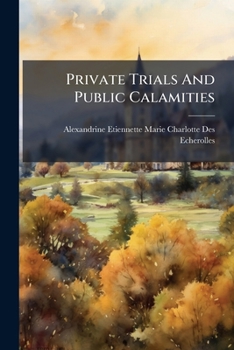
Private Trials And Public Calamities: Or, The Early Life Of Alexandrine Des Écherolles: During The Troubles Of The First French Revolution, Volumes 1-

"Private Trials and Public Calamities" offers a rare and intimate glimpse into the tumultuous years of the French Revolution through the eyes of Alexandrine des cherolles. This compelling two-volume memoir recounts her early life, family struggles, and personal observations amidst the widespread upheaval and societal transformation of late 18th-century France.
Alexandrine's narrative provides a unique perspective, detailing her experiences as a young woman navigating the perils and uncertainties of a nation in revolution. Her account brings to life the dramatic events, political tensions, and everyday hardships faced by ordinary citizens during this extraordinary period in European history.
This historical memoir is an invaluable resource for anyone interested in understanding the human dimension of the French Revolution, offering insights into the era's complex social dynamics, political conflicts, and enduring legacy. It is a poignant and captivating read, showcasing the resilience and spirit of those who lived through one of history's most transformative moments.
This work has been selected by scholars as being culturally important, and is part of the knowledge base of civilization as we know it. This work was reproduced from the original artifact, and remains as true to the original work as possible. Therefore, you will see the original copyright references, library stamps (as most of these works have been housed in our most important libraries around the world), and other notations in the work.
This work is in the public domain in the United States of America, and possibly other nations. Within the United States, you may freely copy and distribute this work, as no entity (individual or corporate) has a copyright on the body of the work.
As a reproduction of a historical artifact, this work may contain missing or blurred pages, poor pictures, errant marks, etc. Scholars believe, and we concur, that this work is important enough to be preserved, reproduced, and made generally available to the public. We appreciate your support of the preservation process, and thank you for being an important part of keeping this knowledge alive and relevant.
Customer Reviews
ThriftBooks® and the ThriftBooks® logo are registered trademarks of Thrift Books Global, LLC
