


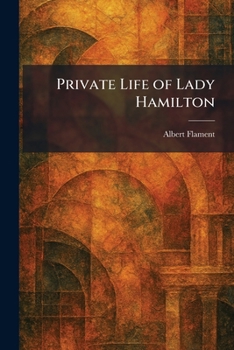
Private Life of Lady Hamilton

Select Format
Select Condition 
Book Overview
"Private Life of Lady Hamilton" offers an intimate and compelling look at one of the most fascinating figures of the Georgian era. Born into poverty as Amy Lyon, the woman who would become Emma, Lady Hamilton, ascended the social heights of 18th-century Europe through her extraordinary beauty, wit, and resilience. This biographical work explores her evolution from a painter's model for George Romney to the wife of the British envoy to Naples, Sir William Hamilton, and ultimately, her world-renowned and scandalous romance with the naval hero Lord Horatio Nelson.
Albert Flament weaves a narrative that captures the vibrancy of the Napoleonic age, detailing the political intrigues of the Neapolitan court and the social pressures of the British aristocracy. The book delves into the "Attitudes" for which she was famous-living tableaux that captivated the elite-and examines the complexities of her public image versus her private struggles. As a study of a woman who wielded significant unofficial influence during a period of global upheaval, "Private Life of Lady Hamilton" remains a poignant exploration of fame, love, and the precarious nature of social status. This account provides essential historical context for understanding the domestic life and personal sacrifices behind some of Britain's most legendary historical figures.
This work has been selected by scholars as being culturally important, and is part of the knowledge base of civilization as we know it. This work was reproduced from the original artifact, and remains as true to the original work as possible. Therefore, you may see the original copyright references, library stamps (as most of these works have been housed in our most important libraries around the world), and other notations in the work.
This work is in the public domain in the United States of America, and possibly other nations. Within the United States, you may freely copy and distribute this work, as no entity (individual or corporate) has a copyright on the body of the work.
As a reproduction of a historical artifact, this work may contain missing or blurred pages, poor pictures, errant marks, etc. Scholars believe, and we concur, that this work is important enough to be preserved, reproduced, and made generally available to the public. We appreciate your support of the preservation process, and thank you for being an important part of keeping this knowledge alive and relevant.
Customer Reviews
ThriftBooks ® and the ThriftBooks ® logo are registered trademarks of Thrift Books Global, LLC
