


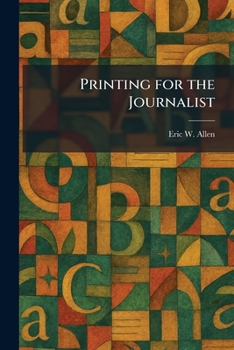
Printing for the Journalist

"Printing for the Journalist" is a detailed and practical handbook designed to bridge the gap between the editorial desk and the print shop. Written by Eric W. Allen, this work serves as an essential guide for journalists, editors, and students of media who seek to understand the mechanical and artistic processes that bring the news to life. It provides a comprehensive look at the world of typography, typesetting, and layout during a transformative era in American newspaper production.
The text covers vital topics such as the selection of typefaces, the technical operations of the composing room, and the principles of effective page design. By exploring the mechanics of the linotype and the intricacies of makeup and press work, Allen offers the journalist a deeper appreciation for the craft of printing. This knowledge is presented not merely as technical data, but as a tool for improving the clarity and impact of journalistic communication.
As a significant historical resource, "Printing for the Journalist" captures the height of the letterpress era and offers invaluable insights into the industrial standards of the early 20th-century press. It remains a fascinating study for anyone interested in the history of journalism, the evolution of graphic design, or the physical history of the printed word.
This work has been selected by scholars as being culturally important, and is part of the knowledge base of civilization as we know it. This work was reproduced from the original artifact, and remains as true to the original work as possible. Therefore, you may see the original copyright references, library stamps (as most of these works have been housed in our most important libraries around the world), and other notations in the work.
This work is in the public domain in the United States of America, and possibly other nations. Within the United States, you may freely copy and distribute this work, as no entity (individual or corporate) has a copyright on the body of the work.
As a reproduction of a historical artifact, this work may contain missing or blurred pages, poor pictures, errant marks, etc. Scholars believe, and we concur, that this work is important enough to be preserved, reproduced, and made generally available to the public. We appreciate your support of the preservation process, and thank you for being an important part of keeping this knowledge alive and relevant.
Customer Reviews
ThriftBooks ® and the ThriftBooks ® logo are registered trademarks of Thrift Books Global, LLC
