


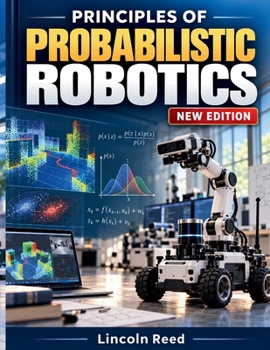
Principles of Probabilistic Robotics: Bayesian Filtering, Localization and Mapping for Autonomous Machines.
No Customer Reviews

Every autonomous robot operates in a world it can never fully see. Sensors lie. Motors drift. Maps are incomplete. The robots that succeed anyway aren't the ones that eliminate uncertainty - they're the ones engineered to reason about it correctly. This book shows you how. Principles of Probabilistic Robotics is a rigorous, ground-up treatment of the mathematical framework behind modern autonomy - the same reasoning that powers self-driving vehicles, warehouse fleets, planetary rovers, and service robots navigating unpredictable, real-world environments. Written for upper-level undergraduates, graduate students, and working engineers, it builds one continuous, unified toolkit - not a disconnected grab-bag of algorithms - from the ground up. What sets this book apart: Nothing is handed to you unexplained. Every algorithm is derived, not just stated - so you understand why it works, not just how to call it.Dozens of fully worked numerical examples, solved by hand, make the mathematics concrete enough to implement with real confidence.A genuinely cumulative structure - each chapter builds directly on the last, so filtering, localization, mapping, and SLAM emerge as one coherent argument rather than isolated topics.Practice problems with complete solutions throughout, built for readers who want to test their understanding, not just skim it.Whether you're building your first state estimator, searching for a dependable graduate-level reference, or shipping autonomy software that has to work outside the lab, this book gives you the reasoning behind the systems - the part no tutorial or documentation page will teach you. Uncertainty isn't optional. Mastering it is. Get your copy today and start building robots that know what they don't know.
Format:Paperback
Language:English
ISBN:B0HMFH6Z2M
ISBN13:9798160929538
Release Date:October 2026
Publisher:Independently Published
Length:366 Pages
Weight:1.87 lbs.
Dimensions:0.8" x 8.5" x 11.0"
Customer Reviews
0 rating
Copyright © 2026 Thriftbooks.com
Terms of Use | Privacy Policy | Do Not Sell/Share My Personal Information | Cookie Notice | Cookie Preferences | Accessibility Statement
ThriftBooks ® and the ThriftBooks ® logo are registered trademarks of Thrift Books Global, LLC
ThriftBooks ® and the ThriftBooks ® logo are registered trademarks of Thrift Books Global, LLC
