


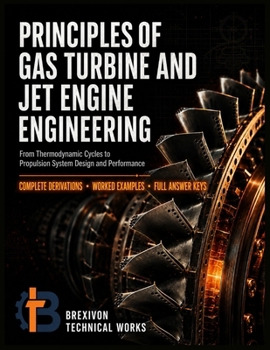
Principles of Gas Turbine and Jet Engine Engineering: From Thermodynamic Cycles to Propulsion System Design and Performance

Anyone can memorize the thrust equation. Far fewer can explain WHY raising the turbine inlet temperature helps - what limits it, and exactly what a designer sacrifices to push it higher.
That gap - between applying a formula and truly understanding it - is where most propulsion education quietly stops. This book is built to carry you across it.
Principles of Gas Turbine and Jet Engine Engineering develops the entire subject from its foundations. Every formula is derived, not dropped on the page. Every calculated number carries its units. Every assumption is stated plainly, so you always know when a result can be trusted - and when it can't. The book reads as one connected argument: from the thermodynamic language of the working fluid, through the Brayton cycle, to the ideal and real analysis of the turbojet, and finally to the machine itself, component by component.
What you'll master:
- The Brayton cycle - and where a real engine's efficiency actually goes
- Ideal versus real turbojet analysis, station by station, with every loss accounted for
- Inlets, diffusers, and nozzles, from subsonic flow through supersonic
- Axial and centrifugal compressors: velocity triangles, stage loading, surge and stall, and how to read a compressor map
- Axial turbines: the work balance, choking and flow capacity, and the hot-section limits that govern the whole engine
- Combustion: stoichiometry, zoning, and the three competing demands every combustor must satisfy
- Off-design matching, turbofans, and augmented cycles
- Materials, blade cooling, installation, emissions, and noise - the real constraints that decide whether an elegant cycle becomes a viable engine
Worked examples make each principle visible. End-of-chapter practice problems - each with a full answer key - let you prove you can apply it yourself.
Who it's for: the upper-level engineering undergraduate meeting propulsion seriously for the first time, and the early-career engineer handed a cycle deck or a compressor map and asked to make sense of it. If you study or work in aerospace, aeronautical, or mechanical engineering - and you want turbomachinery to finally make sense instead of intimidate - this is your book.
Finish it, and you won't just compute the thrust of a turbojet or the work of a compressor stage. You'll be able to explain, defend, and extend every result - reasoning from physical principle the way a working engineer must.
Build the understanding that separates the engineer who can apply a method from the one who can create it. Add Principles of Gas Turbine and Jet Engine Engineering to your cart today - and start reading the engine the way its designers do.
Related Subjects
Engineering Science Science & Math Science & Scientists Science & Technology TechnologyCustomer Reviews
ThriftBooks ® and the ThriftBooks ® logo are registered trademarks of Thrift Books Global, LLC
