


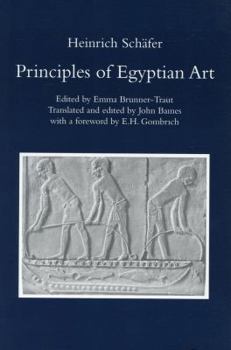
Principles of Egyptian Art: Edited by Emma Brunner-Traut, Translated and Edited by John Baines with a Foreword by E.H. Gombrich
No Customer Reviews

Select Format
Select Condition 
Book Overview
This classic book, first published in 1919, is one of the most importantworks of Egyptology, and is of great significance to art historians, aestheticians, and psychologists working in related fields. In theground-breaking study Heinrich Sch fer set out to analyse and elucidatethe representational conventions of Egyptian two-dimensional art, and toexplain how they differ from Western conventions that have perspectiveat their core. He showed that Egyptian representation is based more onmental processing than on direct perception, and that the aim ofEgyptian artists was to depict an object as it really is, rather than asit appears to be. Egyptian approaches to representing space were alsoconditioned by this aim. The author extended this fundamental insight tocover almost all apparent anomalies in the Egyptian rendering of nature.His conclusions can be compared with analyses by psychologists that arebased on the very different area study of children's drawings. Theobservations of Sch fer and other art historians, and those ofpsychologists, have led to a characterization of polar tendencies inpictorial representation that might be termed 'conceptual' and'perceptual'. Sch fer extended his conclusions, which were based onpainting and relief, to encompass statuary, as well as providing aconcluding synthesis.
The present book, based on the fourthGerman edition of 1963, edited after the author's death by EmmaBrunner-Traut, was first published in 1974. In the course of translatingit, John Baines, who is Professor of Egyptology in the University ofOxford, revised the text and illustrations to take account of recentresearch. This reprint incorporates numerous additions and somecorrections, keeping the book abreast of work in the field.
The present book, based on the fourthGerman edition of 1963, edited after the author's death by EmmaBrunner-Traut, was first published in 1974. In the course of translatingit, John Baines, who is Professor of Egyptology in the University ofOxford, revised the text and illustrations to take account of recentresearch. This reprint incorporates numerous additions and somecorrections, keeping the book abreast of work in the field.
Format:Paperback
Language:English
ISBN:0900416513
ISBN13:9780900416514
Release Date:January 1986
Publisher:Peeters
Length:572 Pages
Weight:2.55 lbs.
Dimensions:1.3" x 6.1" x 9.1"
Customer Reviews
0 rating
Copyright © 2026 Thriftbooks.com
Terms of Use | Privacy Policy | Do Not Sell/Share My Personal Information | Cookie Notice | Cookie Preferences | Accessibility Statement
ThriftBooks ® and the ThriftBooks ® logo are registered trademarks of Thrift Books Global, LLC
ThriftBooks ® and the ThriftBooks ® logo are registered trademarks of Thrift Books Global, LLC
